Criticalista has moved – you will be redirected to http://criticalista.com

Criticalista: 2013/01

2013/01/25

Pseudo-Choice

Potato chips, or crisps, come in a fantastic panoply of artificial flavors. BBQ, Ketchup, or "regular" are standards the world over. Then there are also what we might call "regional" chip flavors, such as wasabe in Japan, Dijon mustard in France, or cured ham in Spain. Recently, two very interesting new chip flavors came on the market in Spain: "FC Barcelona" and "Real Madrid".


The rivalry between these teams is legendary, of course, extending well beyond the football pitch and into just about every other aspect of life in Spain, especially politics: FCB is a symbol of Catalan nationalism while RM symbolizes Castilian centrism.

Yet, lo and behold, both of these potato chips taste exactly the same. Their saltiness, texture, color, and even the sound they make when consumed are identical. At least, I would think, one of these might taste like "calçots" and the other "cocido madrileño". No such luck though.

But then, maybe these chips are not about chips at all. In fact, all this really has nothing whatsoever to do with junk food gastronomy. No, this is entirely about merchandising and product tie-in; a perfect example of form over content. The chips are just a pretext for us to "freely" choose and buy a banner through which to assert a "personal" identity.

The scary thing is that sameness cynically and manipulatively disguised as democratic choice--this pseudo-choice--is not just happening in the world of potato chips, but in politics, cities, architecture, product design... wherever things are tarted up on the outside to appeal to a different identity, but in reality contain nothing but more-of-the-same on the inside.

We are what we are sold, not what we eat.

2013/01/21

Invisible Architecture: Turó de la Rovira Memory Landscape


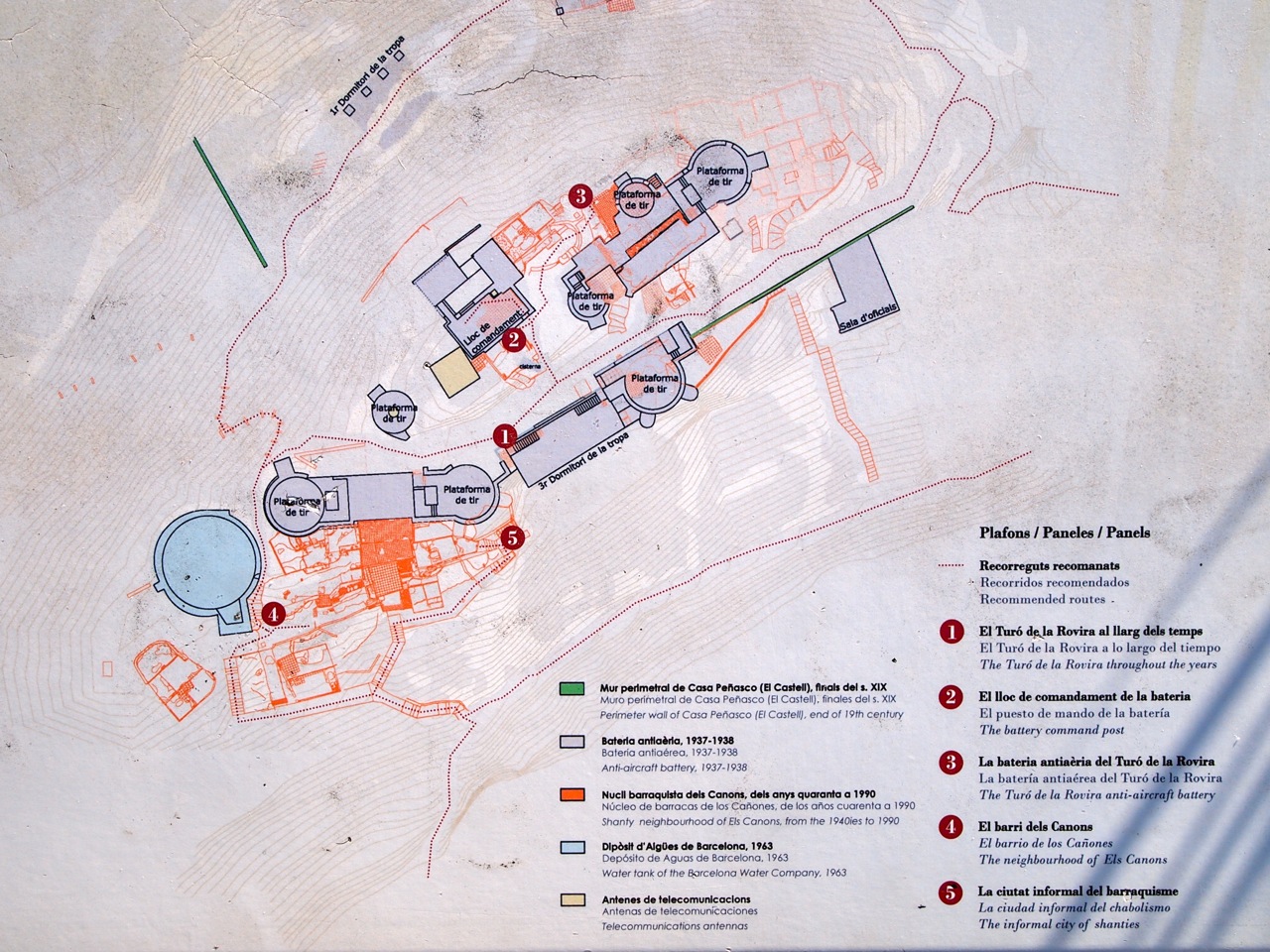
Why is it that, in places where nothing is needed, there is often nevertheless a nagging architectural compulsion to add something anyway, be it an object, a folly, a pavilion, a convoluted pergola...whatever?  I started asking myself this question (again) after a recent hike on the Turó de la Rovira, the highest of the six hills that puncture Barcelona's urban fabric. The hill is best known locally for some anti-aircraft bastions remaining from the Spanish Civil War (the first war in which the aerial bombardment of cities took place). Later, from the 1960s to the early 1990s, the hilltop was the site of a shantytown built by migrant workers from southern Spain. Most recently, after degenerating for some years into a needle park, this area was transformed into a sort of "memory landscape" which went on to win the 2012 European Prize for Urban Public Space. Naturally, I wanted to see this place for myself.


When I arrived at the top of the hill, however, I wasn't at first very certain that I had reached the site of a prize-winning work of landscape design. That's because there was no "design" evident, except for a few Corten steel handrails which I took as a subtle but sure sign that this must be the place I had set out to see. (Other than the news of the prize, I hadn't read about the project itself, so I didn't really know what to expect.)

Slowly, however, as I noticed what appeared to be some not-very-ancient ruins of houses abutting the bastions, it became evident that the architectural design-idea of this public space consisted of creative revealing or peeling-away of layers instead of the usual (this being Barcelona) creative construction. Ordinary hollow-core brick wall remnants, concrete steps, and gaudy 1970s floor tiles--remains of the shantytown--together with the restoration of the bastions are the only elements that comprise this project. OK, yeah, the handrails too.


Architects JDVDP and AAUP evidently intended to reveal existing archaeological layers rather than to add, perhaps somewhat presumptuously, a new layer. To that end, the designers' hands are invisible, imperceptible. Certainly, there is no object, no logo, and no architectural drum solo. What is there? A richly layered place where it's alright to tread on the ruins. Nothing else was needed here, and luckily for all that fact was recognized.