Criticalista has moved – you will be redirected to http://criticalista.com

Criticalista: Art
Showing posts with label Art. Show all posts

2014/01/26

Everything is Art

ARCO art fair, Madrid.
In September 2012, the fiscally and socially retrograde People's Party governing Spain raised the value-added tax on most items to 21%, breaking one of its most-repeated election promises and causing damage to a culture industry already battered by the economic crisis, not to mention impoverishing even further the "working" and middle class. Well this past week, not even one and half years later, the same government announced a reduction in the VAT charged on sales of works of art to 10%. 

This is obviously good news for art galleries, art collectors and white-collar criminals, for whom art collecting is an effective method for laundering cash. It is also encouraging news for the dying entertainment arts sector, which could be next if this policy is expanded to other arts. But is it good news for architecture? Well, building materials are still taxed at 21%, and there is no expectation that the "building art" might enjoy a similar reduction. The artisans who know the arts of plumbing, masonry, carpentry, welding, or "painting", must, in theory, still charge 21% VAT for their services. Other, more essential art-forms such as clothing, shoes, bicycles, or flatscreen television monitors are also still charged 21%, without likelihood of any break in sight.

But there's an easy solution for every Spanish retailer who wishes their goods would similarly be charged less VAT: rebrand their store as an "art gallery" instead. If art can be anything, then anything can be art, right?

Thus, a hardware store could simply become an art gallery specializing in "sculpture and installation art". In such a scenario, fluorescent lighting would be displayed on the floor, with a lot of space around it, and urinals would be displayed upside down. In the back shed where building materials are stocked, lumber would be strewn all about, as if a tornado had struck.

Similarly, a fashion retailer might merely add the word galería to their shopfront, since fashion boutiques look so much like art galleries already. HiFi shops would become sound-art galleries, while stores selling TVs would become galleries specializing in video-art.

Every month or so, new exhibitions would be installed, invitations would be sent out, and cava would be served to smartly dressed, highly discerning but vacuous snobs engaged in chit-chat and vicious gossip while completely ignoring the art as well as most of the rest of the people in the room.

Every single Spaniard would become a gallery-goer. Not just on Thursdays after work, but every weekday as well as Saturday. And if enough of us could actually land a steady job and start buying at these galleries, instead of just looking, then we might even become the country with the most art collections in the world.


2014/01/09

Ice Fishing in Gimli, a book project by Rob Kovitz


One of my favorite publishers, Treyf Books, is celebrating its 25th anniversary. To mark the occasion, Treyf is offering, for the first time, Ice Fishing in Gimli, a book project by my good friend Rob Kovitz, as a downloadable PDF that can be purchased online. Weighing in at a whopping 258 megabytes, the digital version of this incredible work costs only 50 Canadian dollars. That works out to only $0.19 per Mb, which is comparable to the price per mega-bite of bacon at Loblaw's.

Now if you think you have to be an ice fishing enthusiast to be able to enjoy this art-book project, think again. Ice Fishing in Gimli is not about ice fishing. Nor is it about Gimli, Manitoba; that quaint, quiet little town on the shore of Lake Winnipeg that became famous after being mentioned on The Simpsons. In fact, I really don't have a clue just what, precisely, Ice Fishing is about, because it's really about so many things in the end. In fact, it comes darn close to being a fairly sound theory of everything.

My collection of highly prized Treyf books occupy a position on my bookshelf to the left of the Oeuvre complète of Le Corbusier, and to the right of Architecture: A Performing Art by John Andrews. Even though Treyf's motto is "keep refrigerated", I have found that these books resist spoiling even when the summer temperature in Barcelona exceeds the mid-thirties.

How do you read an eight-volume, 4750 page work that is comprised entirely of found images juxtaposed with quotations taken from all sorts of sources, ranging from literature to religious tomes to product catalogs? You don't. You just pick one of the eight volumes at random, open it randomly, and then let it take you for a ride. It's the same kinda fun as opening an encyclopedia: you never know what sort of factoid you're gonna come across, and where it's going to lead you. In fact, come to think of it, Ice Fishing can be seen as an encyclopedia of sorts, just one that is based more on an application of the critical paranoid method to everything. Especially things Manitoban.

If the advantage of the box set copy of Ice Fishing is serendipitous browsing, the advantage of the digital version is that it can be searched for any word, or combination of words. So if you enter, say, the words "Canadian" and, umm..."tire" you get a typological analysis of a chain of suburban big box stores specializing in automotive, sporting, hardware and gardening supplies. Too cool! For academics and researchers, this should prove especially useful.

Geez, I wonder if the PDF version of Ice Fishing is also best kept refrigerated?

2013/05/16

Provocative Architecture?


In "Little Frank and his Carp", a 2001 video of a performance by artist Andrea Fraser, architecture, replete with its institutional frame, becomes a stimulus for masturbation. Is this architecture at its most provocative? No, unless this was part of the architect's design intention; something which only Frank Gehry can tell us for sure. Architecture can't take all the credit here: it takes two to tango.

2012/05/30

Architectural Art

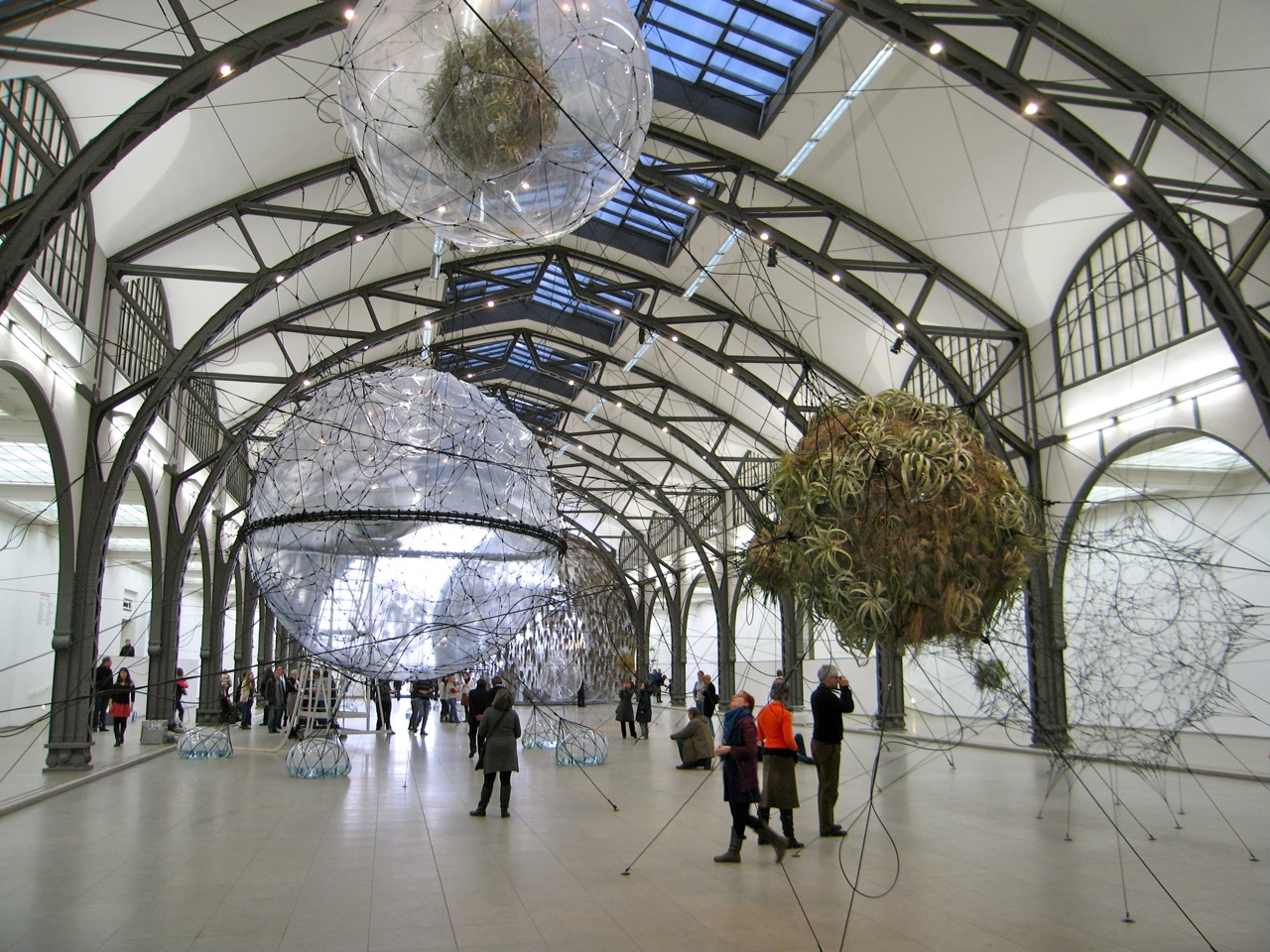
Tomas Saraceno's Cloud Cities installation at Hamburger Bahnhof in Berlin 

Art galleries and museums seem to be showing with greater frequency artworks about architecture, many of them by artists who have studied architecture.

It's all very interesting, but is it architecture or is it art?

After all, art is a discipline that is completely open to every conceivable method, medium, and process. It has, for about a century now, been freed from the traditional academic categories of sculpture, painting and drawing to include conceptual art, installation art, performance art, land art, video art, photo-based art; and what we might call "architectural art" (which is arguably a form of installation art). Art is no longer restricted in terms of media, and is no longer practiced exclusively by painters or sculptors, but by artists who use multiple types of media to explore certain ideas from different angles. Architecture can be one of these ideas, and architectural construction one of those media, but if it's in an art institution, then it's art, not architecture.

There are fundamental differences between art and architecture. The most important one being that art is autonomous, while architecture has only a degree autonomy. In other words, art has an artistic freedom that architecture does not. But here we're obviously talking about architecture as "buildings", not gallery installations. As soon as an architect constructs something in a gallery (or in any institutional context involving a gallery or museum), then architecture becomes art.

When architecture occurs outside the privileged context of an art institution, however "artistic" or "sculptural" it may be, architecture will be architecture and not art.


2011/03/26

Pop Architecture

Ordinary, everyday objects--that's what most architectural sobriquets refer to. A gherkin, a paperclip, a typewriter, a stapler, mushrooms, milk cartons, cereal boxes, dildos... These kinds of endearing associations create a pop-cultural world parallel to Claes Oldenburg and Coosje van Bruggen's, whose inflated, oversized banal objects are exactly what the "untrained eye" seems to see in many buildings.
"La macchina per scrivere" (the typewriter), Rome.
"La grapadora" (the stapler) by MBM, Barcelona
"De paperklip" (the paper clip) by Carel Weeber, Rotterdam.
"Las setas" (the mushrooms) by Jürgen Mayer H., Seville.
"El tampax" (the tampon), by Toyo Ito, Barcelona
"La pedrera" (the stone quarry) by Antoni Gaudí, Barcelona.
La colmena (the beehive), by Taller de Arquitectura, Barcelona
La gasolinera (the gas station), by Viaplana, Piñon, Miralles, Barcelona
"The gherkin" by Foster, London
La râpe à fromage (cheese grater), Roger d'Astous & Jean Paul Pothier, Montreal
La chute à linge (laundry chute) by Moshe Safdie, Montreal (photo courtesy nwaonline.com)
One of many "milk cartons" by IKOY, Winnipeg


"El Toblerone", Almería. Image courtesy salvemoseltoblerone.org

2008/10/07

Soft Architecture

"There will be...a reaction against the rigid, rectilinear architecture expressed in such structures as the United Nations Secretariat building. Buildings of the future will be soft and pliable. Constructed from products derived from atomic chemistry, they will change form constantly according to changes in atmospheric pressure and temperatures."

-Salvador Dalí, "Soft Architecture", 1956

2008/09/22

Architecture Beyond Talk

"Out There: Architecture Beyond Building" is the title of this year's Venice Biennale of Architecture, curated by Aaron Betsky. The implication here is that architects do more than "merely" build buildings. So what else do they do?

Firstly, it has to be said that there has been no shortage of construction activity at this biennale. There are lots of highly labored installations of drawings, models, photographs, furniture, sculpture, and even some full-scale constructions one is actually allowed to enter and (gasp!) touch. I guess that's the "building" part we were expecting anyway. Architects are hard-wired to build, when all is said and done. Fine. But what else is there beyond all the steel, wood, plastic, styrofoam, projections, monitors, paint and lighting that transcends building?

There is one added element in the Arsenale group exhibition (curated by Betsky himself) that is telling. The Arsenale exhibition includes, beside each installation, a panel printed with a "manifesto" together with a portrait-mounted LCD monitor displaying a video of the architect talking about their work. This multi-media form of extended labeling is intended to explain each architect's installation, which might not otherwise be understood. Normally, the texts of extended labels are written by the curator of an exhibition, and limited to a paragraph or two. Here, the architects have been given a voice, as it were, to explain their designs themselves.

Indeed, the architects were each asked to issue their own
manifesto, no less. As Betsky states: "The architects communicate with the visitors by means of their Manifestos, declarations of intent presented by the authors themselves to involve the visitors in their visions and in their idea of architecture."

Manifestos became fashionable in the early 20th century, when avant-garde artistic and architectural movements were sprouting in Paris, Rotterdam, Berlin and Moscow. They went out with the rise of Post-modernism and the fall of the Berlin Wall, or at least that's what we thought. The Arsenale exhibition oozes with avant-garde overtones, not only because of the manifesto panels, but also because of the earnest and sincere tone with which many of the architects talk in their videos. "We must..." comes up frequently.

It is interesting to compare this biennale of architecture to its art sibling. Artists are not required to explain their work, but when they do, they very rarely use the urgent, serious and missionary tone of a manifesto. If they did, it would probably be taken with a large dose of irony. It would seem then, at least from visiting this exhibition, that what architects do "beyond building" is above all talk. Seriously.


2008/06/01

Exquisite Corpse: CaixaForum Madrid by Herzog + de Meuron


A large sculpture next to a mega monochrome painting – at first glance and from a distance, that’s what the serrated box and vertical garden of the new CaixaForum Madrid resemble. A Per Kirkeby next to an oversize Ad Reinhart or Brice Marden in an unknown green period, or perhaps a public piece by Claes Oldenburg and Coosje van Bruggen.

The building by Swiss architects Herzog & de Meuron and the vertical garden by French botanist Patrick Blanc amount to a brilliant urban intervention that has transformed the site of a former power plant and petrol station in central Madrid into an important new addition to the city’s ‘art triangle’, an area formed by the Prado, Reina Sofía and Thyssen-Bornemisza Museums. Nonetheless, the resemblance of this intervention to sculpture and painting raises questions about contemporary architecture’s fascination with art. Even the ‘secular’ work of Herzog & de Meuron – indisputably the favorite architects of the art world – is clearly inspired by modern and contemporary art. Barcelona’s Forum 2004 Building, with its highly textured Yves Klein Blue-coloured skin, is a direct homage to the artist who invented that shade of blue.

Yet, as artists such as Sol LeWitt have written, architecture is not art, and it is particularly ironic that so much cutting-edge architecture currently reminds us of the most traditional forms of art – sculpture and painting – precisely at a time when contemporary art seems to be almost anything but sculpture and painting. I’m not referring here exclusively to Herzog &de Meuron, but to all the usual suspects. It has to be asked whether architecture is really advancing when it seeks to become an inhabitable form of sculpture. If art, as is so often said, is a mirror held up to the world, then architecture, the very construction of the world, cannot be the same sort of mirror. As an old-school professor told me in my formative years: ‘An artist can make a square wheel, but an architect’s wheel must always be round.’

CaixaForum Madrid is the newest of a series of ambitious social and cultural outreach projects of the Fundación ‘la Caixa’, a private philanthropic foundation funded by one of Spain’s larger financial institutions. Like the CaixaForums in Barcelona and Palma de Mallorca, Madrid’s is a centre for exhibitions of ancient, modern and contemporary art (including works from the Fundación ‘la Caixa’ contemporary art collection), music and poetry festivals, debates, seminars on contemporary issues and educational workshops. And like most of the foundation’s building projects, which include CosmoCaixa science museums in Barcelona and Madrid as well as smaller cultural and social centres in Catalonia and the Balearic Isles, CaixaForum Madrid has a social agenda that includes the preservation of a significant piece of built heritage. CaixaForum Barcelona, by Arata Isozaki, involved the adaptive reuse of the Casaramona textile factory designed in 1909 by Josep Puig i Cadafalch. Similarly, CaixaForum Madrid recuperates the Central Eléctrica del Mediodía, a power plant designed in 1899 by architect Jesús Carrasco-Muñoz.

It is well known that the art world generally prefers older buildings – especially those linked to a region’s industrial heritage – over completely new architecture for exhibiting visual art. The patina of worn and weathered buildings, according to many artists and curators, suits the display of contemporary art better than brand-new sterile spaces, though I suspect their preference may emerge in part from a predisposition for buildings that look like buildings and not like sculptures. The most monumental manifestation of this aesthetic preference is, of course, London’s Tate Modern, another power plant transformed by Herzog & de Meuron, although the prototype for exhibiting art in industrial buildings originates in the use made of New York warehouses by American minimalist and conceptualist artists of the 1960s and ’70s.

In the case of CaixaForum Madrid, however, the appropriation of historical architecture is superficial: only the exterior walls of the Central del Mediodía have been preserved. Inside these walls – as well as above and below them – the construction is contrastingly new. Moreover, the historical building has been completely recontextualized: the heavy plinth that originally supported the power station has been removed and replaced by three points of support, causing the building to appear to levitate over the site. As a result, it is no longer self-evident that this was the original site of the Central del Mediodía. Industrial architecture is so rare and out of place in Madrid, the monumental capital of Spain, that one could easily imagine this building floating to the site all the way from Barcelona, Spain’s industrial capital and, incidentally, the headquarters of ‘la Caixa’. Indeed, with its addition on top, CaixaForum recalls the many 19th-century buildings of Barcelona’s Eixample district that were expanded vertically by as many as four storeys during the latter half of the Franco dictatorship, a period of rampant real-estate speculation.

CaixaForum Madrid appears, then, to be a palimpsest, a collage, an exquisite corpse. But this is just an exterior reading: in addition to the elevated hybrid building, there is also a hidden underground component extending horizontally beneath the plaza. This underground component can be reached only after penetrating the elevated building through its topographical underside, by means of a sculptural winding stair that ascends from the plaza into the lobby. Here, a single picture window frames a view of Madrid’s Botanical Gardens across the busy Paseo del Prado and a segment of an adjacent block of buildings whose end wall supports Patrick Blanc’s vertical garden. To continue from the lobby to the rest of the building, the visitor must enter a stairwell that leads up to two exhibition galleries, a bar-restaurant and administrative offices; and down to an underground auditorium and lecture halls. The stairwell, a tapered vertical shaft, is important for structural reasons: it is the largest of the three vertical supports that elevate the building above the plaza. As the shear- and torsion-resistant structural core of the building, it functions like the vertical core of any high-rise building, except that it’s roomy and admits daylight from above. But the stairwell is no ‘museum atrium’ either: it is completely out of view with respect to the rest of the building, precisely because of the load-bearing and fire-resistant role of its heavy white concrete walls. In this regard, CaixaForum marks a significant departure from current art-museum thinking, in which galleries are typically organized around a central, brightly lit atrium to which visitors periodically return, as part of a strategy to alleviate disorientation and museum fatigue. The opacity of the structural stairwell separates each floor completely from the others; consequently, depending on the level at which one exits the stairwell, the décor could change completely. The lobby, with its bright silver beams, contrasts with the white terrazzo floored galleries, the natural wood and dark red-brown perforated metal of the underground spaces, and the delicately screened daylight passing through perforated Corten steel in the restaurant. Here, CaixaForum marks another significant departure from current museums: the building interior is neither monotonously monochrome nor ‘purist’ in an ‘honest’ display of construction materials. Like an urban palace– the first art gallery – CaixaForum contains a variety of differently finished rooms. Paint and interior wall coverings are no taboo for these Swiss architects.

Although CaixaForum Madrid appears at first glance to resemble supersize art, up close it reveals itself to be surprising, eclectic and complex. It incorporates the façade of a historical building that has been emptied, but unlike the common heritage practice of ‘façadism’ –whereby a historical surface is used to camouflage modernity – the historical façade of this building functions as a character foil to some radical moves. CaixaForum Madrid appropriates many art-world architectural conventions but subtly turns them upside down. Precisely what the best art and architecture have always done.

[originally published in Mark Magazine #14]

2002/05/11

The Virtue of Reality: “Puntos de luz”, the butterfly effect, and (web) site-specificity

The butterfly effect, first formulated by meteorologist Edward Lorenz in the 1970s, “refers to the idea that whether or not a butterfly flaps its wing in one part of the world can make a difference in whether or not a storm arises one year later on the other side of the world.” It is therefore impossible, even in theory, to make predictions about the behavior of chaotic systems such as the weather system. Or artist Chema Alvargonzalez’s aleatory installation project titled “Puntos de luz”, whereby anyone with access to the internet can turn on the lights that he has attached to the exterior walls of the recently inaugurated CaixaForum in Barcelona (originally the Casarramona textile factory, by architect Josep Puig i Cadafalch, 1910-11).

The two sites of this project—the building and the web—are each vital to the idea and functioning of the installation: without either, the electrical circuit would be incomplete. In other words, this web site is not just a promotional or explanatory accompaniment to the art, but a component that makes the work interactive, dynamic, and therefore unpredictable. Furthermore, this web site makes it possible to cause a real (albeit minor) change in a real place: to turn on a light bulb in Barcelona. Very few web sites are “really” interactive. Most so-called “interactive” web sites enable only virtual interaction. 

The installation “Puntos de luz” can be seen, then, to be reversing the usual roles played by so-called “real” and “virtual” realms: the web site is a physical switching mechanism; while the building’s blinking lights are a transmitter of information; a “web-o-meter” that indicates the amount of (inter) activity on the web site, not unlike the way a modem’s LEDs blink to indicate the sending and receiving of bytes.

This reversal between the real and the virtual complicates the notion of site-specificity in art. As is by now well known, site-specificity became a central concern in art with the emergence, in the 1960s and 70s, of new artistic practices such as installation art, land art, minimalism, conceptual art, and performance art. While expanding the field beyond painting and sculpture, these emergent practices also sought to engage the physical context of a work of art. The notion of ‘place’ and the tectonics of a particular building or landscape—or a particular type of building or landscape—became an inseparable component of the art. A marked preference continues to exist in contemporary artistic practice for physically integrating works directly with the ground of landscape or the floors and walls of buildings, obviating the traditional role of the pedestal in sculpture and the picture-frame in painting.

Since the emergence and recent popularization of the internet, the web is becoming another important site and form of artistic practice. In addition to the many “virtual galleries” that can be visited on the internet, many established art institutions run web-based programs in addition to their building-based programs. Unlike museums made of bricks and mortar, virtual museums stay open 24/7 and are much less expensive to build, maintain and program. Despite references to “firewalls” and “portals”, the internet has no physical architectural elements, of course. It is an abstract, atectonic space that is nowhere in particular and yet accessible from anywhere; a tabula rasa that is virtually free of contingency—the perfect non-place. Nothing, it seems, could be further from the notion of site-specificity and the idea of place than the internet.

Yet one could say the same about the idea of the paradigmatic “white cube” gallery space a type of space that has been the subject of much artistic investigation and critique. This kind of gallery space is generic and architecturally abstract, appearing, often, to set itself apart from its urban context. Just as the traditional frame and pedestal were used to separate and “elevate” the work of art from the architectural chaos of the salon-type exhibition space, so the white cube gallery separates the work of art from the urban chaos outside. The white cube is hardly any more conducive to site-specific art than the internet, then.

We might see “Puntos de luz”, perhaps, as a “web site-specific” installation that capitalizes on the enormous outreach of the internet precisely to induce reflection on the very idea of site-specificity in the age of the internet. When you turn that lightbulb on in Barcelona, think about what the flap of a butterfly’s wing has been known to cause on the other side of the ocean.

[Originally published in www.puntosdeluz.net]

2002/03/09

From White Cube to Big Box: Three Exurban Themes in the Work of Kim Adams


Kim Adams, Minnow Lure

[originally published in 2002 Biennale of Sydney: (the world may be) fantastic]

"Non-places are the real measure of our time; one that could be quantified...by totaling all the air, rail and motorway routes, the mobile cabins called ‘means of transport’ (aircraft, trains and road vehicles), the airports and railway stations, hotel chains, leisure parks, large retail outlets, and finally the complex skein of cable and wireless networks." –Marc Augé

In a recent solo-exhibition at the Power Plant Contemporary Art Gallery in Toronto, Kim Adams's large, colourful sculptures were displayed on heavy-duty warehouse shelving that lined several walls of that gallery's vast central space, permitting a rotating display of his works to occupy the floor. This industrial-commercial display strategy was not only entirely consistent with Adams's practice of ad hoc appropriation–his sculptures are assembled from consumer goods–but was also very effective at transforming the cultural geography of the gallery space, temporarily converting an urban art gallery (itself, interestingly, a converted industrial building) into its very antithesis: a "big box" warehouse store of the sort that can be found on the sprawling fringes of cities the world over.

The work of Kim Adams is very much about place. In particular, it is about the non-place of contemporary "exurbia." Kim Adams addresses the aesthetics of the changing, dynamic zone at the edge of the contemporary city; the space of agri-business, "new" tract-houses, shopping malls, warehouse stores, automobile dealerships, industry, trucking depots, new and improved roads, recreational parks; as well as landfill sites and garbage dumps; the space of both dreams and derision. It is this geographic transition zone between the rural and the suburban–and the human values that are invested in it–that forms the critical subject of Adams's work. I would like to discuss three exurban themes that resonate in Adams's work: populism, automobility and utopia.


"Many people like suburbia." –Robert Venturi

Suburbia, the condition that has given rise to the exurb, is the common referent of North America; its popular voice and the base of its populism. Kim Adams understands this populism: he celebrates DIY culture, invites active participation, and employs the stratagem of the decoy as a vehicle for people to access his work.

DIY culture thrives in exurbia. On farms, doing-it-yourself is a necessity, while in suburban neighbourhoods it is a widely practiced hobby. Rural and suburban houses are typically stand-alone structures constructed of "stick-frame", lending themselves particularly well to self-modification, while driveways, farm sheds and garages offer ideal spaces for those who are mechanically inclined to modify vehicles. DIY itself represents an independence from the aesthetic dictates of urbanity. In addition to comprising a form of bricolage itself, Adams's work is also largely inspired by his ongoing research into popular bricolage. He has built up an exhaustive collection of "research slides" documenting "ordinary" street remakes of vehicles, trailers and homes.

Adams has also experimented extensively with installations and vehicles that invite viewers to participate in his work. In early works such as Mini Ride (1984) and Toaster Ride (1985), he constructs roller-coasters outside and inside the gallery respectively, inviting the public to ride them with himself present as Carney. Other sculptures, such as Gift Machine (1988), which hands out gifts to passers-by, are conceived to occupy streets and other public places, and instigate conversations. Interestingly, when the question "is this art?" is inevitably posed, Adams does not reply in the affirmative because, as he puts it, "then the conversation just ends right then and there." Adams presents himself precisely as an "ordinary person" and not as an artist in order to engage, rather than alienate, an exurban sensibility that is often hostile to contemporary art.

Familiarity is present in Adams's work as well, functioning also as a vehicle for popular engagement. His sculptures are assembled from ordinary objects of the sort one finds in "big-box" warehouse stores; anything from car and truck parts and industrial hardware to patio furniture, gardening equipment, sports gear, and children's toys. With their familiar logos, bright colours, and oftentimes seamless assembly, Adams's sculptures resemble, at first glance, a new line of consumer products, thereby acting as "decoys" that lure shoppers into the world of art.


"That's what a house is: it's where you keep your stuff while you run around getting more stuff."–George Carlin

The automobile is to the suburban house what the elevator is to the skyscraper: it is the mechanical invention that is necessary in order to make the building type inhabitable. Yet while both the house and the car represent the most important purchases of a typical suburban family, aesthetically, the automobile is inversely related to the house. The suburban tract house is typically conservative and conformist, while contemporary automobiles are works of cutting-edge design. A car expresses a great deal more about the aesthetic predisposition, taste, and personality of its owner than does a house, which must always display a polite facade. Indeed, for many the house represents a solid financial investment while the car is seen as a disposable toy. The house is expected to accrue in value while the car depreciates rapidly, placing the two in a compensatory relationship.

Works such as Chameleon Unit (1988) and Two Headed Lizard With a Single Shot (1986) appear to hybridize vehicle and home. Both of these works are on wheels–as are indeed most of Adams's works–yet both also make reference to domestic architecture by means of garden sheds, recalling the suburban house's lesser cousin, the mobile home. Interestingly, trailer parks with mobile homes–communities often disparaged as "trailer trash"–are often the first kind of residential architecture we encounter when we approach a city, representing the suburban dream of living between city and countryside par excellence.

The trailer is the leitmotif of Adams's work. Earth Wagons (1989-91), for example, in addition to being a trailer itself, also plays host to a number of reduced-scale models of trailers. Symbolizing automobility par excellence, usually for escaping the city, trailers are the very embodiment of modernist-utopian values such as modularity, standardization, flexibility, freedom of movement and living in proximity to nature.


"The whole of French soil should be turned into a superb English park, adorned with all that the fine arts can add to the beauties of nature." –Claude-Henri de Saint-Simon

Exurbia has been the subject of much utopian thinking. From Ebenezer Howard's Garden City and Frank Lloyd Wright's Broadacre City through the recent "New Urbanist" experiments of Seaside and Celebration–all sited well away from pre-existing cities–finding an ideal synthesis between town and country has long preoccupied utopian thinkers.

It is in Adams's miniaturized scenarios that he most directly addresses utopian ex-urbanism. Adams works with reduced-scale similarly to "real" or full-scale: he buys ready-to-assemble kits that are mass-produced and available commercially, then joins the parts in unorthodox ways. What is significant here about the use of the reduced scale-model, however, is that it provokes more than a passive gaze; inviting the viewer to actually dominate over it. It is for this reason that reduced-scale models, from museum dioramas to architects' models and model train sets, have long been objects of popular fascination. A model is no more than a representation of something real or imagined, but, whether it is an art object, a means for visualizing a three-dimensional design or a toy, a model is also an idealization of that which it represents; something more perfect than the "real" thing. In fact, a scale-model is utopian, since it is placeless and free from contingency. Models are other, alternate worlds upon which real impulses, including those of mastery and domination, can be projected.

Adams's miniaturized works, like their full-scale counterparts, also act as decoys, concealing something behind the attractive appearance of a consumer product–in this case that of a model train set–in order to lure the viewer. The expectation of models is that they are perfect, harmonious places, and it is this very expectation that makes the scenarios played out in Adams' models effective. In Earth Wagons (1989), for example, leisurists and tourists–modern nomads–can be seen happily playing in a landscape that has been devastated by the very infrastructure of tourism and consumerism: by an excess of roads carrying excessive traffic, factories spilling chemicals, and garbage dumps full of discarded products. The landscape, though exaggeratedly dense, is nevertheless ex-urban. As with every utopia, we realize that a promising appearance conceals, in fact, a nightmare; that it contains its very opposite.

By way of its exurban nature, then, Kim Adams's work can be seen within the art world as iconoclastic. The art world is highly urbanized: its capital is New York City, the densest, most urban environment in the world. Its biennials, such as this one, happen in major urban centres. Contemporary art is, moreover, highly differentiated from the more traditional, folkloric and craft-based art-forms that are more typically based in rural regions. In this regard, Adams is clearly an urbanite, but one who brings ex-urban culture into the city and secularizes its most sacred spaces. The work of Kim Adams bridges not only high and low, but also centre and periphery.

2001/02/07

Kitbashing, street remakes, and bisexual architecture: a conversation with Kim Adams


Research slide from the collection of Kim Adams


Rafael Gómez-Moriana: Kim, you gave a talk in 1988 at the Christiane Chassay Gallery in Montreal in which you showed slides of "street remakes": vehicles and buildings re-made by their owners, such as buses with beetlebody roofs, pick-up trucks with home-made campers and other creations of a do-it-yourself culture. What struck me about these often quite humorous images was that, collectively, they constituted a typological study - or a body of research - into a pop-vernacular building tradition. How do you come across all this material: do you just bump into it while motoring across the Arizona desert? And secondly, how does this research inform your practice?

Kim Adams: My research began in high school while I was skipping classes. I found street life more interesting. Later, I began traveling with a caravan as part of late-hippie culture: in those days, converting your bus was what you were supposed to do. Paint it yourself, make the roof higher, start having babies, start traveling. It was a freedom culture of sorts, and I did enjoy the idea of being a gypsy. I was a musician at the time too, playing in acoustic love bands. One day, I came out of an art gallery in Victoria and there was a vehicle that somebody had converted for hunting. From that point on my art practice changed and I just started seeing these things all over the place: a bus with a Fargo van on the top where the kids would stay. A lot of those finds were accidental but I was keeping my eyes open. People have also contributed to the slides - sometimes students will give me some when I do a talk. When I moved to Ontario this culture had disappeared. It's rare, it's really rare to find these things today. There isn't as much experimentation. Things are pretty well done and bought as is. The inventiveness is not there anymore. My father's generation could fix things with a little binder twine, while today we have to trade it in or have somebody else fix it. The old Volkswagen was something that could be rebuilt and made into something else. You made love in it, you listened to Jimi Hendrix in it, you got married in it. The cottage business or street industry is quite rare today. I mean, getting licensing in Toronto is very difficult: when we did the Curbing Machine in 1988, we had to get a permit and a license, and we had to lie about it. We got it under the category of being a dumpster, because it was on the sidewalk as well as on the road. So it was a dumpster. With the Toaster Wagon in San Diego, the officials seemed to run out of the office every time we requested a permit. We only got busted a couple of times, and they couldn't even describe it to head-quarters: "What is this?" "Well, actually, it's two VW buses. " "On the sidewalk? How did it get on the sidewalk?" And I would just say; "It's the back ends of two buses put together to look like a toaster." "Well, next time you come here, don't go on this side of the street, go on that side of the street."

RGM: Why wouldn't you just tell the authorities or whomever that it's art?

KA: Because then the conversation just ends right then and there. When someone would ask, "What is this?" and I would answer, "It's a Curbing Machine - do you want to try it?" they might become interested. But if I said, "It's an artwork," they'd ask "Who's paying for that?" The subject of the conversation becomes the taxpayer. But when a work just sits in an abstract, quiet way people do a second take on it. French-fry truck, that's right. Ice-cream truck, that's right. Satellite dish spinning around with man sitting next to it. That's not quite right. And then it's: "How much, how much?" "Nothing. Just try it." "Well what's supposed to happen?" It would keep the conversation going. When I did all three of my machines on Granville Island in Vancouver, which is near an art school and therefore a trained area, the trained people came up and said, "This is artwork right?" And I would reply, "No it isn't." "I know it's artwork! I saw the poster!" "Yeah right, OK. Go away, will ya?" I'm waiting for tourists. I don't need conversation about whether it's good or bad art.

RGM: You seem to enjoy a rapport with your audience. Earlier installation works, such as Leisure's Restraint at the Ydessa Gallery, consisted of rides that gallery visitors could actually enjoy. You would even be present to assist with the operation of the rides and to answer any questions. Where does this interest in your audience come from? Why do you care so much about your audience?

KA: My first ride piece was at the garbage dump in Victoria. The gallery thing had already been done and I was looking for some other venue. So I got permission and built an interactive possibility for whoever hangs out in dumps. That was my audience and it worked out fine at first, but then somehow it got press and became public. Media people were coming over from Vancouver, as well as bus tours. It got on the art circuit and that just completely changed it. Then I was asked to do a gallery show in Santa Barbara along the same lines. What happened was wild. The entrance ride came into the corridor and crashed through this truck. There was another ride called the Moon Ride - a half inch steel rolled plate that would crash into the main building support and shake it. A third ride involved going through a video room. I wanted an attendant so I became that attendant. At the dump, though, I wasn't an artist, I was just this guy, and people were asking "What are you doing?" I was testing myself. "What do you do with it?" "You get inside it and then it just moves." Then people would come back and bring the kids, and teenagers came on Friday nights. I was living nearby in my van at that time and got to know this other culture, as well as the police, who kept on moving me away. From there, this idea of movement went into galleries for awhile. The gallery itself was a learning experience for me: what do you do with that space? What is it? What is its meaning? The Curbing Machine came out of these questions, the idea of just planting this thing outside the gallery in the street and seeing what happened. And sitting at the same street corner for a month, there are enough lessons in that memory for a lifetime.

RGM: So being an attendant at these rides you created was really a pretext for observing people - for conducting more research?

KA: Sure, but it was also to see how comfortable it is for people to get up on a platform with a spinning disk - I had to provide something to hang on to.

RGM: These sound like architectural concerns. Indeed, it seems that many of your works are inhabitable or proposing some form of inhabitation.

KA: Almost.

RGM: Alright, almost inhabitable. I'm thinking here of the Decoy Homes and Auto-Office-Haus. Of course, as an artist all media are open to you but this isn't the case for architects. Architecture carries a degree of public responsibility, from which art is exempt. Do you ponder this question much? Does the fact that you're an artist make your architecture any different?

KA: Well, I would love to say it's architecture, but it's not. I learned that in 1988 when I built the Chameleon Unit. I flirted with the idea that it's possibly architecture, but just a little. The Decoy Homes come out of Donald Judd's work at that time, the earlier plywood boxes on angles. Riding a train across Ontario I noticed between here and Windsor there are more garden sheds than houses. Viewed abstractly from the corner of an eye, these sheds look just like houses; the same dumb shapes. The idea of a model emerged: why not buy three or four of them, stack them, and make a Surfer Shack. I was just borrowing what the urban realm offers, but in abstract. Looking at it as abstract forms allows you to borrow from it. I was finding stuff at Canadian tire. That was the beginning of my shopping. There was a whole period when I was building things from scratch and trying to re-invent the wheel; in fact I was often trying to make four wheels exactly the same. I didn't see the simple side: it took a lot to find it. And that was Canadian Tire. "Four lawn chairs and three garden sheds, please," and I would just set them up in the studio. But how they work as models is important because garden sheds are not made for people. So that's where the Decoy Homes become models, or maquettes. There is a little bit from the visual world of architecture, though. The Chameleon Unit, the truck piece, was the first piece I made that you could actually live in. I could buy these units that are made for truckers to sleep in and convert them into "apartment" units in the plaza in front of the new American Express building at Battery Park in New York City. It got reviewed in Architecture magazine as an ashtray, this horrible ash tray right in front of this beautiful piece of architecture. So in 1988 I learned that there might be a difference here, and now I never say I make architecture. Gordon Matta Clark's work was not accepted as architecture, even though he studied it. When he shot those windows out of the Institute for Architecture and Urban Studies, that was an architectural show and architects dumped on him. I mean it was the art world that enjoyed the curiosity of the difference between art and architecture and it crossed over that way. When I worked in Germany there seemed to be a conversation with my work that I wasn't experiencing so much here, where I am a freak or a weird guy. In Germany I was taken quite seriously: Auto-Office-Haus was looked at as a serious proposal. They didn't talk a lot of art at all, but said it was bisexual architecture. I had to look more at the living possibility of the structure, effectively propose it as a small living space.

RGM: The history of architecture is full of proposals that have remained unbuilt, and indeed some proposals have been designed to be unbuildable.

KA: This is probably where we sympathize with each other. Unrealized projects are celebrated in Germany now; the unrealized has actually become subversive. The conversation came up a lot: "We'll realize this project." In Canada our problem is that things don't get realized. Here, the unrealized is a reality.

RGM: So all of your works are models, whether full-scale models, or miniature scale models. How did you actually get into miniature scale? Was it through constructing studies for your larger models?

KA: My first memory of sniffing glue at a young age was when I built a model kit of President Kennedy's boat. After that I was constantly building models. Especially cars. Model building was big. Then it disappeared. At the University of Victoria I got back into making model cars because It seemed to make more sense than learning abstract painting or something like that. The first car piece I ever saw was by Joseph Beuys at the Guggenheim in the 1978-79 retrospective. He had a VW bus on the ramp, together with the survival sleds. And it just made so much sense right there in that gallery, which is basically a car park. Just think: Winnipeg, Regina, these prairie towns, they all have mini Guggenheims. I think that made quite an impact on me, just seeing a car in that high-art situation. I didn't understand the survival part. I was just thinking, “Ooh, cars look alright in galleries, especially old, rusty ones.”

RGM: Both your full-scale work, if we can call it that, as well as your miniature work, is assembled from off-the-shelf components, things you can buy, whether actual car parts or model-car kits. Where does the "craft" come into it? Is craft even important here?

KA: It's making these model-building kits look like the period. that's what the craft is. Painting it to look aged and square; they have to look how the kit's supposed to be made. But then it's also when you start "bashing" them. All my work is what I would call "kit-bashing." This is a common term in the model industry: you cross breed a Volkswagen with a Cadillac, and you've got a kit bash. They must do it in architecture too, although I don't know if they talk about it in those terms.

RGM: In architecture there's a lot of value placed upon a kind of originality that has to do with having things made from scratch. It's very much an Arts-and-Crafts ideal. In fact, a lot of architects have a disdain for ready-made products from catalogues because these products are associated with commercial building production. Meanwhile, you've even begun incorporating action figures in your work.

KA: The Breughel Bosch Bus is a proposal for an amusement park - Breughel-Bosch Land - at Niagara Falls. The work is a theme park at 1:87 scale, so the bus itself would be about twelve stories high. You take your family through this late industrial-age North American steel plant turned amusement park. The action figures are there to make the piece believable as a proposal for fiction but it's also about the shutting down of the steel industry in many towns.

RGM: Much of your work deals with the average middle-class family's two principal purchases: the house and the automobile. Yet, while the typical new house today is backward-looking, cars are cutting- edge design. There's a real irony to seeing a new "ye-olde" tract house with a sleek late-model car parked in the driveway. If you look at historical photographs of the villas of Le Corbusier, on the other hand, it is the cars that Le Corbusier liked to park in the foreground as symbols of modernity that look antiquated today, not the villas. In the Decoy Homes, for example, the house becomes a vehicle and the vehicle a house. A lot of your work is about mobility as lifestyle but it's a lifestyle that is less current today.

KA: It's from my parents' generation, no doubt. But I don't know what is going to happen with the next generation; maybe they'll have computers in the trailers. When I was invited to do Chameleon Unit and they gave me some money I felt guilty and I didn't want to make something that wasn't functional. If it fails as art, at least then you can still live in it! Or sleep in it. That work really came out of a fear of being homeless.

RGM: Are you still shopping at Canadian Tire as much as before or are you working with different kinds of components now that require other sources?

KA: When I first discovered Canadian Tire as a source for art materials I would get a buzz. Everything on the shelves - from ironing boards to cups and tents and fishing rods - turned into art supplies. Canadian Tire became an exciting place to be. The garden sheds were my first entry because they were always on display outside. Everything was there, including the hardware to put things together. No welding: everything had to be fastened mechanically and treated as a supply. But some of that excitement wore off after ten years. I still check it out - I keep my eye out for new models, such as the Space Saver shed - but I don't buy as much from there. In 1991, I made a new work because they came out with a new model. I've been increasingly investigating other industries. I'm looking for new shapes so that's what's making me move to other places. The computer has generated a curiosity for making shapes. Right now I'm working with GM and Ford, just for the new shapes and bodies - especially the new truck bodies. And working with a company here in Toronto that makes interesting computer shaped cargo boxes for trucks. We're working on a project in Vancouver that'll become a housing workshop that folds out so that a little truck comes out of there that has fake artworks made of wood, rubber and plastic stacked to look like hamburgers and desserts. The whole thing will look like a gift shop. With miniature models it's the same: they're all available materials. They're all industrially made, so pretty well anything I want to put together I can find. Specialized model stores have become a major new supply.

RGM: If you could do a residency in any factory, store or warehouse that you desired, where would you choose to go?

KA: Well it would be automotive, probably where they build the Smart Car in Germany. The place where Airstream trailers are assembled would have been wonderful earlier. In Europe, they're interested in having artists working in industry. I was approached by BMW but I wanted to take the shell off a BMW and make it look like another car and they weren't into that. They Just wanted me to paint one. I said "Can I drill holes? I've got to do something else with it!" And that was the end of that project.

RGM: In your earlier work you fastened things together that were always recognizable, whereas it seems that in your more recent work one can't quite recognize the components as readily.

KA: Yes, the recognizing gets a little bit more special this time. You have to look more carefully. The language has become more specialized. It's still off-the-shelf, but now stuff is kit-bashed in such a way that it becomes its own image. I'm always surprised at the many people playing with the Toaster Wagon who don't know the spokes. And then there are people who recognize it right away: "That's what I thought it was!” With others, I've had to tell them, "No, it didn't come like this; it's two old VW buses." With other models you'll recognize a tractor cab, but a corn feeder from combines? It's allowed me to expand into the full range of kitbashing possibility. It's finding the parts! I could design from scratch, perhaps using computers. But I still have to have that satisfying level. I think if I was asked to build some of these models I have here strictly from scratch I would be very unhappy. Combining things together is satisfying in some way.

[originally published in C International Contemporary Art #70, summer 2001]

2000/01/01

Winnipeg: One Great Situation-Normal (1)

"Incredible...one can actually order ‘a cup of coffee’ here without having to specify in greater detail the particular brewing method, the type of coffee bean, the darkness of the roast, or even the flavour. It’s even served in a ceramic cup!" (2)

Winnipeg is the ‘ordinary Canadian’ of cities. Not many other Canadian cities can lay claim to being situated right in the middle of the Trans Canada Highway; nor are many situated on land as flat and undramatic as the Red River floodplain. How many other Canadian cities are as averagely-sized --let alone bilingual? Or able to consistently produce the most reliable test-market data on the viability of new consumer products before they are launched in the rest of the country, a theory that rests on the underlying principle that if Winnipeggers will buy it, then anyone will? (3) Hard-working and frugal, socially progressive and fiscally conservative, Winnipeg is the urban equivalent of the mythical ‘ordinary Canadian’ who is married, has two-point-three children and a house in the suburbs. (4)

This is not a bad thing, though. Compared with the rest of the western world, in which the run-of-the-mill is increasingly displaced by specialized premium brands, designer labels and authentic reproductions, being squarely in the middle-of-the-road is precisely what makes Winnipeg unique and interesting, if not exotic. It is also, of course, what makes this city quintessentially Canadian. Like a big Value Village thrift store, Winnipeg is the sort of place where the generic and the naturalized that was never even known to have been forgotten can be suddenly and happily rediscovered, and all for a bargain.

But ordinariness is not just the stuff of savvy antique collectors. It is an increasingly current preoccupation in the discourse of contemporary art as well. As the grand narratives that not-so-long-ago purported to tell everyone’s story whither, the idea of art as compensation for the reality that surrounds us becomes displaced by an art that addresses this reality instead. The trivial and the ordinary are therefore becoming increasingly the central subject of art, displacing the emphasis on the unique, the heroic, the individual, and the autobiographical. With its high standards of mediocrity and its location in the middle of the North American continent, (5) Winnipeg is optimally positioned to exploit this growing area of interest, a situation that, if seized, could propel it into the next global art centre, the logical next-step in the westward progression after Paris and New York.

Winnipeg’s artists are already fully aware of this situation, exploring the mundane to its fullest, including its crass and shitty aspects. (6) The city offers artists and other researchers of the ‘aesthetics of the commonplace’ excellent field conditions in which to observe normality. (7) The city’s physical mediocrity is consistent in its quality, and its citizens appear to be very relaxed and unself-conscious about it, even during media occasions such as the Pan Am Games. Indeed, contemporary Winnipeg places greater value on the quality of its daily life than on that of its rare public spectacles: even the architecture of the new food court at St. Vital Mall, for example, is far more impressive than the Investor’s Group Athletics Facility completed recently for the Pan Am Games at the University of Manitoba, a campus whose collection of fine historical and modernist buildings would be complemented far more attentively if it were located elsewhere. Only in contemporary Winnipeg would shopping and other daily activities be accorded greater architectural monumentality than education and sport, the twin pillars that have traditionally stood for the pursuit of excellence. (8)

The disdain for elitism, excellence and international prestige in favour of a somewhat higher quality of daily life for all is of course not unique to Winnipeg, but is by-and-large a Canadian characteristic that, like this country’s extreme weather, happens to be more pronounced in this region. The result is that artists, who in many other cities must struggle to eat, are themselves able to enjoy a better quality of life. It is not uncommon for a Winnipeg artist to actually live in a house and work downtown, a significant step up from having to live in a studio.

Indeed, it is precisely its housing affordability that has helped to spare Winnipeg, to date, from the latest development craze, that of the so-called ‘artist’s live-work studio’. The city has been spared from many other planning and development trends as well, most notably the urban renewal craze of the 1960s as well as its subsequent backlash, the movement to turn historical buildings into ‘ye olde’ heritage. For a city with so much exquisite historical architecture, it is very remarkable how little of it has been commercially redeveloped into artist’s live-work studios or boutiques. What this means, of course, is that Winnipeg’s warehouse buildings are actually used by artists, the very people who would ironically be driven out if such development were to take place. (9)

Winnipeg can be seen, then, as a city that is genuinely ‘artist friendly’. This should, theoretically, fare well for the city in the new post-industrial economy of ideas, images and visual culture. After having occupied the sidelines for so long, Winnipeg’s day could still come thanks, in the end, to its persistence in striving to be ordinary. If the city does become the next global art centre, it will, of course, have to be careful not to spoil the very quality that made it great. But who would ever have thought that mediocrity could possibly become a virtue in the new world order?

NOTES:

1. The word ‘situation’ refers, interestingly, to both a geographical location (site) as well as to a “condition as modified or determined by surroundings or attendant circumstances” (OED). “Sit(E)ings: Trajectories for a Future,” as an exhibition situated in Winnipeg, provides itself a site for this city’s art. I will therefore speculate on the city as a present and future urban situation that the works in the exhibition may or may not have in common. In any case, specific references to works in the exhibition are made in these notes.

2. An initial personal observation upon arriving for the first time in Winnipeg from LatteLand Vancouver in 1997.

3. Jean Klimack’s installation, in which different kinds of chewing gum were mailed out to different people, chewed, returned and finally displayed in a typological matrix is itself the result of a form of ‘market-research’ into the nuances and subtle variations between different brands of the same generic product.

4. Harry Symon’s on-going work on the Constitution and Paul Butler’s collages using advertisement both comment on the social construction of the ‘ordinary Canadian’: the former engages in the slippery arena of mass-opinion, while the latter reminds us that mass-opinion is fluid and extensively shaped by corporate interests through advertising.

5. Lori Rogers’s complex and poetic video-installation piece and Jake Moore’s rooftop installation are both representations of a diminishing nature. Rogers’s work is abstract and employs a technological medium, while Moore’s is more figurative and craft-based.

6. This strategy is most clearly deployed in the collage work of Jacek Kosciuk, which combines detritus such as recycled KFC cartons with his own imagery, as well as the self-portraits by Christine Kirouac, which reference the glossy PhotoShop™-improved photographs of sports and entertainment celebrities in the weekly media.

7. As Marcel Dzama’s work points out, however, normalcy is never what it seems. His quirky, disturbing world could be a comic-book variation of a David Lynch movie. Yet like all comics and science fiction, they give insight into human nature in general.

8. Blair Marten’s détournements of sports accessories and hand tools, as well as Kevin Waugh’s sofa-legs-cum-tongue can be seen as humorous institutional critiques with a tactile, haptic touch. Their disdain for the overly verbose discourse of art institutions is especially present in their own artist’s statements.

9. Joel Garreau, in his book Edge Cities, notes that suburban enclaves with names like “Cedar Grove” are often named after species of animals or plants that have been eradicated by the very construction of those enclaves. The commercial development of ‘artist live/work studios,’ which often forces artists to move to other areas, proves that this theory applies equally to humans.


[Orignally published in Winnipeg Art GallerySit(e)ings: Trajectories for a Future]