Criticalista has moved – you will be redirected to http://criticalista.com

Criticalista: politics
Showing posts with label politics. Show all posts

2014/02/28

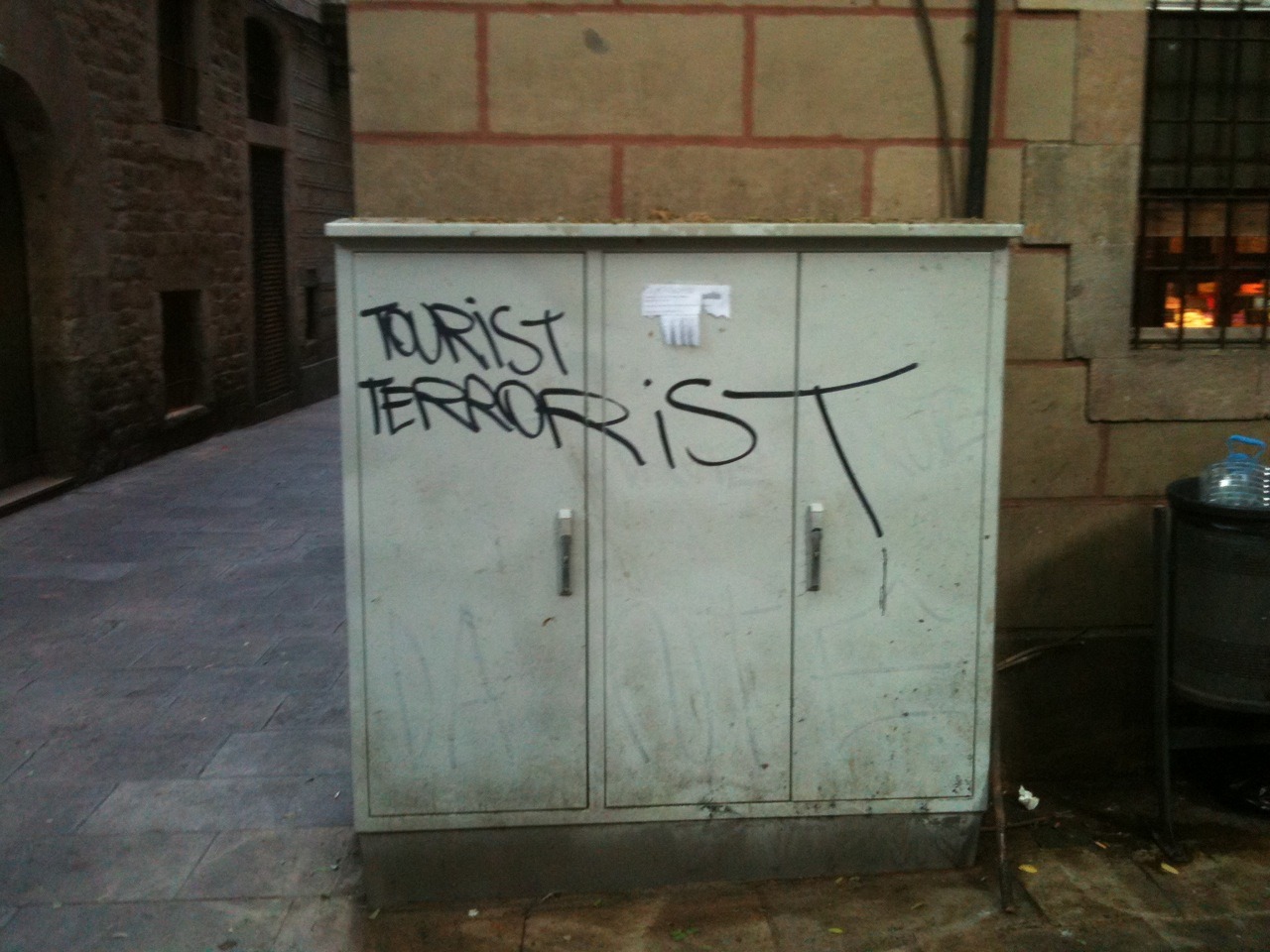
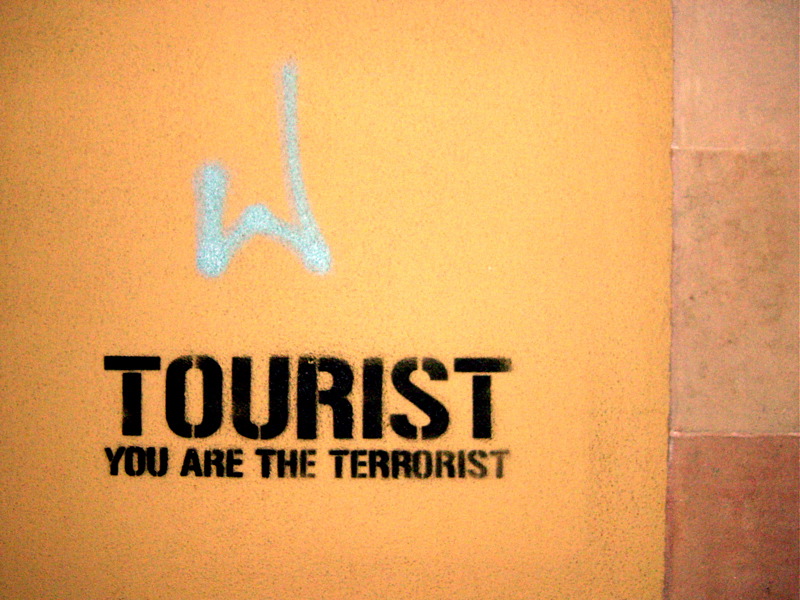
Tourism versus Terrorism


(courtesy photoree.com user jrbrubaker)
(courtesy tumblr.com user noahi)
¿Is tourism a form of terrorism?

Some Barcelonins seem to think so. All over the city --especially near tourists sites-- slogans such as "tourism = terrorism" or "tourist, you are the terrorist" can be spotted stenciled or spray-painted on urban surfaces. Interestingly, as any image search will confirm, these graffitis are themselves a favorite subject of photography and commentary by tourists.

Among the very few industries that has actually grown during the now seven-year long economic crisis in Spain, tourism is increasingly dividing Barcelona's citizens. Those whose livelihood depends upon tourism (including myself, since I earn my living teaching courses to foreign students participating in study-abroad programs together with writing articles about architecture, which is ultimately a tourism commodity) are willing to put up with the inconvenience of busloads of gawkers blocking sidewalks and causing traffic congestion. Besides, I also like to travel abroad whenever I have the time and of course some spare pocket money to spend.

But tourism is viscerally despised by others who critique it as a non-productive industry offering only temporary, part-time seasonal work under usually humiliatingly exploitative conditions; a sector which is controlled by a powerful lobby that is increasingly setting the political agenda of our governments. These detractors see every local family business that is being driven out by a Starbucks or a MacDonald's; every residential dwelling that is converted into a tourist apartment, thereby driving up rents; and every Asian or African immigrant working for peanuts in a restaurant, as being squarely the fault of tourists.

Tourism is big business, and big business is unscrupulous and utterly devoid of ethics --we know that much already. But is it equivalent to the violent assassination of innocent people in order to instill a climate of fear in the population?

A group of 'terrorists' admiring the architecture of Casa Vicens by Antoni Gaudí

2014/01/31

Calatrava May Bleed You Dry, But Who is Ultimately Responsible?


Several Spanish media (such as El Diario and El País) are reporting that Santiago Calatrava is suing Esquerra Unida País Valencià (EUPV), a Valencian leftist political party, to the tune of 600 thousand euros for defamation over a website it launched in 2012 called "calatravatelaclava", or "Calatrava bleeds you dry". The website, a growing collection of news articles documenting problems and irregularities with the Valencian architect, was set up in order to denounce what it calls Caltrava's "ruinous projects and tax-free invoices". The site reveals, for example, public disbursements totaling approximately 100 million tax-exempt euros to Calatrava, whose fiscal residence is Switzerland, along with a litany of technical problems associated with his buildings and bridges.

The architect's lawyers argue that the website is defamatory, that it could never have gained its notoriety --over one million visits and mentions in the NYT and The Guardian-- were it not for Calatrava's international fame, that it is to blame for the cancellation of a commission in Brazil after the news medium O Globo made references to it, and that the site's cover photograph portraying Calatrava in the company of Carlos Fabra and Francisco Camps, two politicians indicted for corruption, creates a misleading impression of the architect.

Calatrava has undoubtedly become somewhat of a scapegoat for all of contemporary architecture's ills. He is of course not the only architect who exceeds budgets manyfold, behaves arrogantly, and builds works that leak or send tid-bits falling onto bystanders. He is simply the most famous architect involving all of the above, and since there is a public backlash against so-called "starchitecture", that makes him an easy target. Is it fair that he is being singled out by a political party and the mass-media? I guess that's the risk involved in the high-stakes game of high-profile architecture. Fame and recognition, which is what motivates young architects most (it certainly ain't the paycheck!) can always backfire at any time, it's worthwhile remembering.

I have never been a fan of Calatrava's work, as my students and readers know, but to be fair, he can't be solely blamed for at least some of the problems his works have incurred. Cost is a good example. Why should architects be the ones expected to keep a building project's cost under control when it is clearly not in their interest to do so? After all, it's the client's money, isn't it? Even in the case of public projects, in which case the client is an elected representative empowered to control the public pursestrings, the architect cannot reasonably be expected to be the one controlling cost. Expecting ambitious architects to control budgets is like empowering hunters to act as game wardens. Duh! Policing should never be left to anyone with ulterior interests, which architects inevitably have despite any rhetoric about defending the public's best interests.

This is precisely what brings us back to the lawsuit. EUPV is obviously trying to bring down the Valencian Popular Party over its irresponsibilities. An architect's head is not the first priority of a political party. The notion of "opposition" is fundamental to democratic political governance, another high-stakes game, especially in Spain, where political parties, like football clubs, can become huge corporations. The elected representatives who gave their amigo Calatrava a blank check are ultimately the ones who have to pay the price. They are the ones who should have known better.

In the meantime, Calatrava should come to grips with the idea that the universe does not revolve solely around him and get on with solving his buildings' many technical problems.

2014/01/12

Power, Corruption and Architecture

Photo courtesy ElMundo.com
Transparency International released its annual report some weeks ago, and this year's corruption perception index, which ranks 177 countries from least to most corrupt, lists Spain as having dropped from position 30 to 40. In just one year.

Yes, you might well ask, but what does architecture have to do with all this?

Well, the biggest corruption scandal of them all, the Bárcenas affair (after Luís Bárcenas, the imprisoned former treasurer of the right-of-centre Partido Popular / PP, which governs Spain nationally as well as regionally in 11 of its 17 Autonomous Regions and locally in the majority of its municipalities), is about supposed illegal party funding during nearly two decades, mostly by construction companies and real-estate developers, who, in exchange for "donations" to the PP party, received favorable consideration by PP-led local or regional governments in the allocation of large public works contracts, or were granted favorable changes to land-use zoning bylaws when building private developments.

The whole racket began in 1990, but it went into high gear in 1998, when land law reforms passed by the Aznar-led PP majority government to facilitate zoning changes stimulated a huge boom in private real estate development that would last over a decade and that, upon bursting, would cause a disastrous economic crisis that is still on-going and seemingly never-ending. The construction boom's huge urban expansions required new infrastructure and public buildings, which in turn meant, of course, lots more opportunities to raise cash for the PP coffers. During the boom, the PP's slush fund was so large that Luís Bárcenas regularly handed out "bonuses" --envelopes containing large sums of cash-- to the party brass, including allegedly Mariano Rajoy, the current prime minister of Spain. Catalonia's ruling right-of-centre CiU party is embroiled in a similar scandal, the Palau case, in which contractors were allegedly systematically charged a 3% fee in the allocation of public works contracts.

Judges and journalists who have tried to investigate corruption networks, such as Judge Baltasar Garzón's probe into the "Gürtel" scandal or the Catalan digital newspaper Cafè amb Llet's uncovering of sleaze in Catalonia's public health system, have been either removed from office or sued for defamation, while a great many politicians accused of corruption are still in office. Corrupt politicians and royalty are defended, ironically, by none other than Spain's special "anti-corruption" prosecutor's office. Talk about impunity.

But what does architecture as distinct from construction have to do with all this?

The fact is that the real estate and public works boom of the 2000s coincides exactly with the period in which Spanish architecture was heralded around the world as exemplary. "Good architecture" thus became an unwitting byproduct of --if not a cynical smokescreen for-- large-scale political corruption. As long as critics, curators, and archi-tourists were gushing over all the fabulous new buildings in Spain, then maybe the hundreds of millions of euros of tax money that was being diverted into the pockets of politicians wouldn't be noticed. Or worse yet--this being the land of the picaresque por excelencia-- maybe such wrongdoing would even be tolerated if it meant Spain was being celebrated in the global spotlight, which it certainly was. The architecture boom was such a good party while it lasted, that nobody wanted to entertain the possibility that architecture, known to march hand-in-hand with power, might also be marching hand-in-hand with XL-size political corruption.

Many ordinary Spaniards are now sickened, not only by negative effects of the construction boom (urban sprawl, thousands of empty buildings, unemployment, forced evictions, polarization of wealth, disappearance of the middle class, etc.), but also by the perception that architecture was somehow either directly or indirectly complicit with the boom. This feeling of betrayal is especially significant because Spanish architects generally enjoyed a high level of citizen respect until recently. Before the death of Franco in 1975, architecture students were an important contingent in the pro-democracy student movement, and a number of architects played leading roles in neighborhood-association struggles to improve living conditions in Spanish cities.

Spanish architecture was thus identified with an incipient democracy movement at one time. Corruption, on the other hand, directly undermines democracy, and it is interesting to note a change that occurred in Spanish architecture from the end of the Transition period to the boom-years of the late 90s and 2000s. Whereas up to the 1992 Olympics most public works projects concentrated on renovating public spaces and building new public institutions (schools, sport facilities, city halls, etc.), usually at the neighborhood scale; after 1997, the year that the Bilbao Guggenheim Museum opened, a new typology emerges that we might call an "architecture of tourism": cultural facilities that are so large, they could only have been designed with hordes of tourists in mind as the principal user-group. Alongside these publicly financed tourism mega-projects, private real-estate development built primarily for purposes of speculation began to spring up. Generalizing grossly, we could say that the pre-Guggenheim period's architecture had the improvement of the lives of citizens as its priority, while most of the building undertaken during the post-Guggenheim boom years now ultimately had tourists and foreign investors in mind, in addition to voting citizens of course.

The more the construction industry profited (and the more they donated to political parties such as the PP or Catalonia's CiU party), the more Spanish architecture excelled in recognition and won international competitions. Coincidence? Or is it merely a case of having to take, as it were, the good with the bad (and the ugly)? The boom is also the period during which a significant number of prestigious Spanish architecture magazines went to global distribution, and when many celebrated architects from abroad started building in Spain and vice versa. Numerous architectural master's programs aimed at foreign architecture students appeared at the same time that many Spanish architecture students and academics went abroad to study or become leading figures at some of the most prestigious architecture schools. Thus, even architectural theory and criticism "boomed" alongside the construction and architecture boom, gaining increasing global recognition.

Spanish architecture thus shifted from mainly local concerns to chiefly global concerns. Accordingly, attention shifted from the concerns of citizens to those of tourists, consumers of global media, international financial speculators, and architectural academia. But all this changed from one day to the next when Spain's feverish construction bubble suddenly burst in 2008.  Architects themselves were not only suddenly out of work, but were also suddenly shunned by a society that until then had regarded them as heroes. Unfair scapegoats? Perhaps. In any case, a profession that was societally respected and internally bonded was now coming apart, both literally and metaphorically. Since the great crash, there has been almost no work, no income, and no optimism. A very high number of architects have been forced to move abroad, some as far as the Americas or Australasia. Interestingly, at this moment more US architecture schools are headed by Spanish architects than ever before (a group colloquially referred to as "The Spanish Armada").

Back in Spain, meanwhile, a law has been tabled to "liberalize" the profession and make it more "competitive" (we all know what that word really means). Enrollment in architecture schools is way down, while paper architecture, collectives, collaborating (once again) with activist groups and neighborhood associations, and un-solicited architecture are up, as are "alternative" spatial practices that approach art. Such alternatives to traditional practice, even if these put yet less bread on the table, show the inventiveness and persistence of Spanish architects, who are some of the best-educated in the world.

We are now being told that the crisis is over, and that it's all going to get better from now on; that our sacrifices are finally bearing fruit. While we are being told this, the majority PP government is passing an anti-protest and hence anti-democratic "Citizen Safety Law" the likes of which have not been seen since the Franco era. Another law designed to protect coastal construction is being reformed to facilitate construction on those few remaining stretches of coastline that have not been destroyed already, while another law is being entertained that would provide an instant Spanish (and hence EU) passport to anyone "investing" half a million euros in Spain; a law obviously aimed at reducing the current surplus of approximately 800 000 apartments. Perhaps the PP ultimately wants to kick-start another con-struction boom; a re-ron. Only this time, the spectacular hotel casinos for both tourist consumption and real-estate speculation in one (giving a whole new meaning to the term "multi-use building") will be built by global developers and their brand of global architects. The Spanish government has already shown that it is willing to bend over backwards (which in Spanish translates as "bajar los pantalones", or lower the trousers) in order to meet the demands of developers, such as easing laws concerning money-laundering, smoking in public buildings, foreign work visas, and of course land-use zoning. What the failed negotiations over EuroVegas reveal is just how low the Spanish government is willing to go in lowering its trousers. The only one of Sheldon Adelson's demands that it couldn't meet was a guarantee that future governments would not recede on the final agreement. A democratically elected government cannot, of course, ever agree to such a condition--only a dictator is in a position to do so.

Although EuroVegas thankfully fell through in the end, the eagerness with which this project was embraced by ruling politicians paints a dismaying picture of Spanish architecture in the coming decade or two. It will likely become two-tiered and highly polarized, just like Spain itself, with a handful of local architecture collectives designing food banks, emergency shelters for the homeless, and Single-Room Occupancy dwellings for NGOs, while a handful of superstar "developer-architects" (with names like BIGGUS DICKUS, Co-opted Himmelb(l)au, OMG, and Frankly Garish) will probably be brought in to design private hotels, casinos, tourist apartments, gated communities and luxury marinas. There will be very little in the way of museums, since so many have been built in the last decade that there is little to no money left for their collections. In fact, public work will all but disappear, since there is little public money anyway, growing public opposition to these kinds of projects, and since it is no longer as profitable a method for filling the coffers of ruling political parties. But the PP party has already found another way to profit from the public sector: privatizing it by selling off public institutions such as Spain's regional health-care or education systems to their cronies.

This time around, "architecture" will have little to gain.


2013/10/26

Looking for Progress Street / Buscando la Calle Progreso


[versión en castellano sigue a continuación]

"Attention. Liberty and Fraternity streets are closed due to road improvements. Temporary detour via Danger Street." That's exactly what the sign says. 

Good to know. Problem is we're looking for Progress street (carrer del Progrés, see map below), and if Liberty has been shut and we are obliged to take Danger street, then that requires crossing Venus street, and we'd rather not upset the goddess of beauty and love in our search for Progress. According to the sign, left turns are not permitted, but taking a series of turns to the right is something we'd much rather avoid. And where is Equality street when you need it most?

Are we stuck? Can anyone provide some useful direction out of this labyrinth? 


"Atención. Las calles Libertad y Fraternidad están cerradas por obras. Desvío temporal a través de la calle Peligro." Eso es exactamente lo que dice el cartel.

Es bueno saberlo. El problema es que estamos buscando la calle Progreso, y si Libertad está cerrada y estamos obligados a tomar la calle Peligro, entonces eso requiere cruzar la calle Venus, y preferimos no molestar a la diosa de la belleza y el amor en nuestra búsqueda de Progreso. Según la señal, no se permiten giros a la izquierda, pero tomar una serie de giros a la derecha es algo que preferiríamos evitar aún mas. ¿Y donde está la calle Igualdad cuando más la necesitamos?

¿Estamos atrapados? ¿Alguien puede proporcionar alguna orientación útil para salir de este laberinto?


2013/09/20

Remembering Marshall Berman

I think it was in 1985. I would have been in my second year of study at University of Waterloo's architecture school, a co-op program in which terms of study alternate with work terms in other cities, and in 1985 I was on my first work term in Montreal. In the 1980s, that city had a public lecture series on architecture organized by Peter Rose and sponsored by the Aluminum Company of Canada, and it was at one of these lectures that I first learned about Marshall Berman. I went to his lecture not knowing anything about him, other than that he had recently written a book titled All That Is Solid Melts Into Air: The Experience of Modernity, and that he was not an architect but a professor of literature.

Whenever a non-architect would speak at the Alcan Lectures on Architecture, the talk would usually not be as well-attended as one by an architect, and some audience members would inevitably get up and leave after hearing only a few minutes and still not seeing an architectural slide projected onto the screen. I decided to stay, because I found what this non-architect had to say to be interesting. I still remember how he opened his talk by recounting his own personal experience of growing up in the Bronx, and how the urban change that was occurring around him at the time--Robert Moses's "urban renewal" projects--were what had prompted him to investigate the question of what it means to be "modern".

For the most part, his talk was essentially a summary of his fascinating book. "To be modern is to live a life of paradox and contradiction. It is to be overpowered by the immense bureaucratic organizations that have the power to control and often to destroy all communities, values, lives; and yet to be undeterred in our determination to face these forces, to fight to change their world and make it our own. It is to be both revolutionary and conservative: alive to new possibilities for experience and adventure, frightened by the nihilistic depths to which so many modern adventures lead, longing to create and to hold on to something real [!] even as everything melts. [...] To be modern is to find ourselves in an environment that promises us adventure, power, joy, growth, transformation of ourselves and the world--and, at the same time, that threatens to destroy everything we have, everything we know, everything we are." How refreshing to hear a discussion of modernity as contradictory and paradoxical, I thought to myself.

Professor Berman then ended his talk with a polemical idea that had a few of the remaining architects who stayed to the end visibly squirming in their seats. He spoke about the chasm between the culture of urbanism, isolated in its ivory tower, and the urban culture that was happening at street level, championing the former to redirect its gaze. To prepare us for what we architects might see, he proceeded to screen some crude, home-made film footage of break dancers and rappers in the streets of some of the less glamorous 'hoods of New York City. This was in 1985, some time before the likes of Public Enemy and Run DMC would catapult rap culture into the mainstream, so it was probably new sound and imagery for most of those in attendance. At this late point in his lecture some more members of the audience got up and left. For me, though, it was an event that motivated me not only to read his book, but to question the way I had until then thought about architecture. Just for that lecture I will probably always remember Marshall Berman.


2013/01/25

Pseudo-Choice

Potato chips, or crisps, come in a fantastic panoply of artificial flavors. BBQ, Ketchup, or "regular" are standards the world over. Then there are also what we might call "regional" chip flavors, such as wasabe in Japan, Dijon mustard in France, or cured ham in Spain. Recently, two very interesting new chip flavors came on the market in Spain: "FC Barcelona" and "Real Madrid".


The rivalry between these teams is legendary, of course, extending well beyond the football pitch and into just about every other aspect of life in Spain, especially politics: FCB is a symbol of Catalan nationalism while RM symbolizes Castilian centrism.

Yet, lo and behold, both of these potato chips taste exactly the same. Their saltiness, texture, color, and even the sound they make when consumed are identical. At least, I would think, one of these might taste like "calçots" and the other "cocido madrileño". No such luck though.

But then, maybe these chips are not about chips at all. In fact, all this really has nothing whatsoever to do with junk food gastronomy. No, this is entirely about merchandising and product tie-in; a perfect example of form over content. The chips are just a pretext for us to "freely" choose and buy a banner through which to assert a "personal" identity.

The scary thing is that sameness cynically and manipulatively disguised as democratic choice--this pseudo-choice--is not just happening in the world of potato chips, but in politics, cities, architecture, product design... wherever things are tarted up on the outside to appeal to a different identity, but in reality contain nothing but more-of-the-same on the inside.

We are what we are sold, not what we eat.

2012/12/12

Strange Bedfellows

Left: Construction of Instant City, Ibiza, in 1971 (photo www.domusweb.it)
Right: Hotel Algarrobico, Carboneras, Almería, 2010.

The image at left shows the construction of the "Instant City" during the congress of the International Council of Societies of Industrial Design (ICSID) of 1971, which was held at the Hotels Cartago and Galeón in Ibiza (visible in the background). The Instant City is currently the subject of a celebratory exhibition at the Macba (Barcelona Museum of Contemporary Art) titled "La utopía es posible."

The image at right shows the infamous Hotel Algarrobico, construction of which began in the early 2000s within the boundary of the Cabo de Gata-Níjar Nature Park--a UNESCO Biosphere Reserve since 1997. Although it has repeatedly been ordered to be demolished by the courts, this never completed behemoth is still standing to date. As part of a 2007 Greenpeace "action" to raise awareness, the words "hotel ilegal" were painted in large four story high letters on its sea-facing elevation. 

The two hotels in these images, whose architecture is not entirely dissimilar, are separated by a distance of only four hundred kilometers and a timespan of only a few decades, yet one is celebrated as the site of an optimistic event that marked a milestone in the cultural modernization of Spain, while another has become the very symbol of political corruption and reckless development in this country. Utopia and dystopia: strange bedfellows indeed.

2012/09/18

Ill-Fitting: The Balenciaga Museum


The Balenciaga Museum: a refurbished 19th-century palace
onto which a vast new glass shed has been added. 

The canted, curving sea-facing glass facade of the addition is
punctuated by clunky emergency exits that appear to be an afterthought.

The shed is symmetrical in cross-section, even though it is built into a steep hillside.


 The care taken by AV62 in the design of the exhibition spaces redeems the building.


Fashion, Architecture, Politics: Image is Everything

The inauguration of a cultural institution is normally a cause for widespread celebration; even more if it is the opening of the world’s first museum dedicated entirely to one couturier. But the long anticipated inauguration in 2011 of the Museum dedicated to Cristóbal Balenciaga in his birthplace of Getaria, a small fishing town in Spain's Basque Country, must have been somewhat awkward, to say the least. The occasion, as reported in national media, was attended by Queen Sofía of Spain, local and national politicians, and dignitaries and luminaries from the international fashion world, for whom the celebrated Basque chef Juan Mari Arzak created a special six-course gastronomical menu inspired by Balenciaga's creations. But there were nevertheless two very conspicuous absences at the inauguration: the former mayor of Getaria who spearheaded the project, Mariano Camio, and the architect who gave it its overall built form, Julián Argilagos. They were probably not invited because of the criminal charges they were facing in relation to the project. In 2007, when the building was semi-complete, a scandal broke out triggered by the apparent theft of some handkerchiefs and other pieces from the museum’s collection. More revelations soon followed: serious irregularities in the awarding of contracts, embezzlement of public money, huge cost overruns, and an unlicensed architect (who was also rumored to be the mayor’s lover). The scandal amounted to terrible publicity for a museum dedicated to a legendary perfectionist: Balenciaga was known to work in relative seclusion and to abhor publicity of any kind.

The corruption scandal surrounding the Balenciaga Museum is a textbook example of the close relationship that exists between architectural and political ambition. A spectacular building is capable of providing both the politician who spearheaded it and the architect who designed it with the very same thing each craves to advance their respective careers: a good photo opportunity. The politician craves photos that will generate news headlines, while the architect craves photo reportage in glossy design media. Regardless of the type of media, the greatest buzz is generated by photogenic architecture. Any politician or architect with the slightest ambition knows this: image is everything. 

Spain, in the nearly three decades between the definitive end of Franco's dictatorship and the onslaught of a devastating economic crisis in 2008, was a particularly rife place for architectural-political ambition. As a relatively young democracy, Spain still feels it has a collective "backwardness complex" it needs to bury once and for all. The construction of new democratic institutions, public spaces and infrastructure became a priority in the first decade, to be followed in the latter two by the construction of world-class cultural institutions. Museums, then very much in architectural vogue, became especially important as a way for Spain to brand itself as vanguard. Or, more precisely speaking, Spain’s autonomous regions, almost half of which speak languages that were suppressed during the Franco dictatorship and which afterward set out to gain greater political power. In Spain, regional identity is a global political issue as much as it a national one, and ambitious architecture was found to be among the most effective vehicles for projecting a regional voice into the global arena.   

Building iconic museums developed into a particularly Spanish kind of “space race” among its provincial cities. The Bilbao Guggenheim Museum by Frank O. Gehry (situated only an hour’s drive from Getaria) is the most famous example, eventually becoming an international media phenomenon. The “Bilbao effect” (a reference to Jean Baudrillard's "Beaubourg Effect") refers to a form of edifice envy among politicians around the world, for whom building a high-profile architect-designed museum became their preferred way to give their city or region an image make-over. If Bilbao is capable of completely transforming its urban image from heavy-industrial “grunge” to post-industrial “chic”, then so can Barcelona or Badajoz. The Bilbao Guggenheim is only one of many museums in Spain by respected national and international designers. In the Spanish vox populi, the new generation of museums 
are so much associated with "architecture" that it is often jokingly commented that museums are visited more for their shells than for what's inside. As we shall see, in the case of the Balenciaga Museum the exact inverse happens to be case: here, it is the container that does not live up to its content. 


The Fiasco

Sure enough, the Balenciaga Museum started out with what are presumably the best of intentions. When Mariano Camio, a charismatic member of the conservative-nationalist Euzko Alderdi Jeltzalea / Partido Nacionalista Vasco political party was elected mayor of Getaria in 1983, he saw building a museum in the place where Cristóbal Balenciaga was born and now lies buried as a way to leave a lasting mark on the town while honouring a native son, and, of course, as a way to put the town on the international cultural tourism circuit. Soon after his election he began to contact families who had been patrons of Balenciaga, convincing them to make donations to a publicly owned collection he was spearheading. He created a foundation to administer the collection and to oversee the design, construction and direction of a future (and "futuristic") museum, recruiting Hubert de Givenchy as its Honorary President. In 1999, Camio and de Givenchy convinced the Basque Government to buy an important collection of Balenciaga’s creations, significantly increasing the size of the Foundation’s collection to over a thousand pieces ranging from dresses for different sorts of occasions to hats and handkerchiefs. Government grants totalling 18 million euros were secured from the Spanish Ministry of Culture and other public sources, and the idea to build a museum had the support of Spanish Royalty, Queen Fabiola of Belgium (whose wedding dress Balenciaga had created), Paco Rabanne, Emanuel Ungaro and Óscar de la Renta, among others. 

The museum project began with the refurbishment of the Berroeta Aldamar palace, a summer residence that once belonged to the Marquesa of Casa Torres, Balenciaga's first client and patron. But it was evident that the palace would be too small, and that an addition would be needed to display the growing collection. This is where Miami-based Cuban architect Julián Argilagos enters the picture. Mayor Camio personally handpicked Argilagos to design the museum, even though he had no experience with a public building of such magnitude. Although the museum was to be built with public funds, no architectural competition was held at the outset--not even an invitational competition. Camio must have been very impressed by Argilagos’s pompous (and erroneous) claim that his museum design, “inspired by Gaudí, American architecture, and Balenciaga himself” would be “the world’s first suspended building”, and that it would “revolutionize world architecture”. This kind of rhetoric sounds overly grandiose even coming from an architect, but it seems to have convinced Camio. 

So, just how was Mariano Camio able to handpick someone to design a public building without going through a public selection process? By creating a private company with himself as the sole signing authority (Berroeta-Aldamar S.L.) which would be directly contracted by the Foundation of which he is the deputy president to manage the construction of the future museum of which he is director and Argilagos curator and exhibition designer. That’s how. The Foundation’s Honorary President, Hubert de Givenchy, as well as most of the patrons of the Balenciaga Foundation were living far away from Getaria, and so were not involved in the Foundation’s day-to-day business. Camio could control everything (or so he thought). Incredulously, construction supervision was also contracted to Argilagos, [1] even though it is standard practice, when a foreign architect designs a building, for supervision and all legal-contractual aspects to be handled by a local "architect of record". Camio must evidently have been convinced that the involvement of any "outside" architect or consultant would only compromise Argilagos's vision. 

The original completion date of the building was originally scheduled for late 2003, but by 2005 construction had only barely begun. By 2007, the foundation, the steel structure, and parts of the envelope were in place, but it was slowly becoming evident that Argilagos could not handle the project by himself. In that year the Spanish Ministry of Culture halted funding when it was discovered that construction costs, initially estimated at 6 million euros, had tripled to 18 million. Camio, increasingly under pressure, fired Argilagos, but not without first paying him an extra 439 000 euros on top of the nearly million he had already been paid in fees.[2] When it was discovered one day that some scarves, handkerchieves and gloves had gone missing from the collection because they had been handed out by Camio as gifts to some of his cronies “for their support during difficult times”, the scandal finally broke in the media. The Foundation’s Honorary President called for Camio to step down, a parliamentary investigation was launched, and construction was immediately halted. 

In order to rescue the project, the Balenciaga Foundation was legally reconstituted in 2008, with Sonsoles Díez de Rivera, a major donor to the Balenciaga collection, appointed as the new director. The new foundation immediately launched an architectural competition. Officially, this competition was  for the museum’s interior and museological design, but it was also obviously intended to correct a wrong that had been committed. The competition was won by Victoria Garriga and Toño Foraster, principals of the firm AV62, a young Barcelona office with a proven record of designing museum exhibitions. But it was a bitter-sweet competition to win: AV62 soon discovered that they had inherited many building deficiencies that had to be corrected late in the game; problems that would further strain an already very limited budget.


The Building

As it stands today, the involuntary architectural collaboration that is the Balenciaga Museum is not exactly the most accurate manifestation of the couturier’s legacy and values. Balenciaga, who likened his métier to that of architecture, was a perfectionist who refined and developed his technique and craft gradually, throughout his entire career. Refusing to follow trends, he was experimental but at the same time extremely rigorous; the two being inseparable from one another in his mind. Balenciaga knew not only how to design, but also how to sew, which he learned as a child while helping his mother, a seamstress. Balenciaga is comparable in this regard to Mies van der Rohe, who had a similar ethic and who also learned to master a craft (masonry) before becoming a designer. Balenciaga's "Miesian" rigor is certainly not honored by the awkward building bearing his name; a building which was ill-conceived from the start, ran amuck, and finally had to be rescued by another architectural firm. If anything, it might provide us with an example of current-day "complexity and contradiction in architecture."

Overlooking the town of Getaria and the Bay of Biscay from a steep hillside, the Balenciaga Museum is essentially a long, sinuous glass shed added onto a nineteenth-century palace (Robert Venturi would of course have done the opposite, adding the palace to the shed). Inside its vast, bright space, a series of smaller, opaque buildings containing exhibition galleries are suspended from trapezoidally shaped steel arches.  The approach from the town is by way of a series of escalators that take the visitor from the main road passing through Getaria to a plaza in front of the palace and, adjoining it, an opaque, black metal end-facade belonging to the addition. A single, elegant angular pleat in the surface makes a minimal entranceway gesture. Upon entering one end of the longitudinal hall directly through the main doors beneath the pleat, the first thing that draws the eye are the long, gently curving canted glass walls on both sides. One of the glass walls faces north over Getaria’s rooftops toward town, sea and horizon, but the other faces south, directly into the sunlight as well as onto a four-story high retaining wall only a few meters away from the glass. This massive retaining wall, which is thankfully softened by vegetation, reveals that a steep, anything-but-symmetrical terrain had to be radically altered in order to accomodate the cross-sectional symmetry of Argilagos's design. 

“Ideally” intended for a flat site, Argilagos's design is essentially a utopian idea forced onto a rugged topography that had to make way. It is a pre-conceived architectural idea brought to a site from elsewhere. The only adaptation to the site occurs in the plan: the curvature of the building follows a topographic contour line. The Balenciaga Museum is thus ill-fitted to its site. With its long, drawn out form and symmetrically canted glass walls on both sides, it would be much more suitable as an airport terminal for a small Spanish town such as, say, Ciudad Real or Castellón. Mundane things like local building codes were evidently not taken into consideration either, judging by the number of fire escape doorways that punctuate the very glass wall graced with a sea-facing view. Due to the cant of the glass wall, and the fact that fire escape doors must, by necessity, be vertical and made of steel, these doorways become clunky, opaque box dormers tacked onto a complex, sculpted, smoothly warped glass curtain-wall. These doors appear to be such a foreign intrusion on the curtain-wall that they could only have been added as an afterthought, ruining what was presumably intended to be the main design feature of the building.

It is not until we finally reach the innermost parts of the building that it begins to look and feel like a museum and not an airport terminal, in large part because at this point that we no longer see the rest of the building. Inside the suspended exhibition spaces, a display architecture comprised of a single, continuous, deeply undulating wall creates smooth, seamless niches within which Balenciaga’s work is sensually  displayed, not unlike virgins in the chapels of a church. The undulating walls in each of the six different exhibition galleries vary in curvature and colour according to the museum’s six different curatorial classifications: “Early Years, Day, Cocktail, Evening, Bridal and Essential.” The hidden lighting sources, the subdued lighting levels, and the unframed glass set into the smoothly curved niches amount to a simple but effective exhibition design strategy that displays Balenciaga’s work with dignity and elegance.


Good News?

It is a miracle that this museum was completed in the end, in spite of all the problems it suffered. The museum has become a popular attraction in Gipuzkoa, despite a building that disappoints for the most part. In the end, the problem is perhaps not so much the building itself as it is the missed opportunity that the building represents. It is what this building could have been that disappoints above all (a type of disappointment only ever suffered by architects and politicians). It could have been so much better; something Balenciaga might be proud of. Instead, he must surely be rolling over in his grave. 

In the meantime, a criminal investigation launched when the scandal broke resulted in Mariano Camio being charged with embezzling public funds, falsification of invoices, and administrative disloyalty. He denies all charges. Julián Argilagos, along with another Cuban architect, is charged with practicing without a license, and is the only one of the three indicted who has yet to appear in court to testify, citing poor health as well as financial ruin as excuses not to travel. Argilagos claims on his YouTube channel that AV62 violated his intellectual property rights by not seeking his permission to make changes to his design. AV62, on the other hand, feels that their right to have been provided a fair opportunity to be awarded this project from the very beginning was violated, and that they have to now cope with the disappointment and frustration of not having been able to do their best work (although they certainly did the best they could under the circumstances). And Mariano Camio? Curiously, nothing is being heard from the person who is ultimately responsible and who should have known better than anyone else that when it comes to excessive architectural-political ambition, media can also backfire. 


[1] http://www.elmundo.es/suplementos/cronica/2009/626/1245535216.html
[2] http://www.independent.co.uk/news/world/europe/museum-accused-of-giving-away-balenciagas-work-789356.html

[a shorter version of this text was originally published in Disegno #1]

2012/07/03

The SuperSize of EuroVegas

The size of EuroVegas in comparison to the city of Barcelona
image courtesy of elgrupusculo.wordpress.com

This map shows what's wrong with the EuroVegas proposal. Barcelona does not have much farmland left within its metropolitan area. To turn among the last remaining 800 hectares of this valuable resource into a Vegas-styled theme park is plain stupidity. 

All the more worrisome, then, that someone like Ferran Adriá (that's right, the famous chef) would come out publicly stating that he supports the EuroVegas proposal. Shouldn't he be more concerned about the quality and provenance of his fruits and vegetables than giving a helping hand to one of the world's biggest gambling magnates? What bad taste on the part of Adriá. How disappointing.

Oh well, there goes the neighborhood.

2012/06/03

Not So Different


"Spain is Different" was a tourism campaign slogan coined in the mid-1960s by dictator Francisco Franco's Ministry of Information and Tourism (!), when it was headed by the late Manuel Fraga Iribarne, a man who would transform into a democrat decades later and continue a long-lasting political career until his death this year at age 90. Fraga's slogan became very effective, not only attracting millions of tourists and therefore much-needed foreign currency to revive Spain's moribund economy decades after its devastating civil war, but also serving to re-brand Spain as "hip"and "fun" at a time when it was isolated and only beginning to gradually open up to the world. Fraga is also known for having relaxed censorship laws during the 1960s, leading to the emergence of the popular expression "con Fraga hasta la braga!" ("with Fraga all the way to the panties!"). Such actions led him to be perceived as a relative reformer from within the dictatorial regime, making him relatively popular at that time. After Franco's death in 1975, however, when students and workers protested massively to demand democracy, Fraga was the Interior Minister who publicly proclaimed "La calle es mía!" ("the street belongs to me!") and ordered police to shoot demonstrators, killing five and wounding many dozen. Needless to say, this heavy-handed action caused him to be largely despised thereafter, ruining the relatively good reputation he had enjoyed until then.

Curiously, a multinational corporation that designs and manufactures computer and entertainment products started out by similarly  branding itself as "hip" and "fun" with a slogan that rings quite similar to "Spain is Different". And now, news of some rather heavy-handed and sordid business practices are similarly beginning to ruin its reputation.

Late in his life, Fraga dedicated his energy to an ambitious cultural and economic development project of which he is the brainchild, the City of Culture of Galicia, perhaps in an effort to restore his legacy. He organized an international competition in 1999 that was won by Peter Eisenman (an article I wrote on it can be read here), but curiously, one of the finalists in this competition, OMA, submitted a design for a building in the shape of a ring (a project which for some reason is not published on OMA's website). Coincidentally, the corporation whose slogan is "Think Different" is expected to soon begin construction of a building designed by Norman Foster that is shaped like...you guessed it: a ring.

Who would ever have thought that the story of a veteran politician from Spain and that of the world's biggest IT corporation could sound so similar, or perhaps better said: not so different?

2012/02/29

The Politics of Crap

Architectural competitions to design *only* the facade of a building are increasingly commonplace in Germany, according to an op-ed piece in the German magazine Bauwelt. These kinds of competitions provide a compromise solution between a city's qualitative interest in maintaing a certain image on the one hand, and property developers' quantitative commercial interest in nothing but the maximum leasable floor area on the other. Architecture is thereby increasingly limited to superficial image, proving Philip Johnson right when he categorized it as "a branch of cake decoration." 


It also proves Peter Eisenman wrong when he says, as he so often does, that architecture built under rightist governments is better than that built under leftist ones. While indeed a very small élitist fraction may be better, the vast majority is utter crap. Perhaps the real question we should be asking this: in which part of the political spectrum does the most crap get built?


2011/12/05

Collective Intelligence, or Collective Stupidity?

Detroit?  Bangkok?  Manila?  Manaus?  South Africa? 
The above image is circulating on the internet accompanied by all sorts of captions of all sorts of cities on all sorts of continents, showing us how images, so easily appropriated and manipulated today, are deployed toward all sorts of ends, all too often sensationalist, demagogical, and misleading.


According to "Del Tirador a la Ciudad", the architecture and design blog of El País, this image is of Detroit, Michigan. Last time I visited Detroit, in 2001, there weren't any palm trees to be found, but who knows, maybe global warming has somewhat altered the flora of the Motor City over the last decade.


I suspect the author, Anatxu Zabalbeascoa, pulled the image from this post at Decrece Madrid, a grassroots environmentalist, anti-consumerist and anti-capitalist organization in Madrid calling for the "degrowth" of that metropolis. 


In both of the above websites, this image of "Detroit" serves to highlight the built manifestation of extreme socio-economic contrast, which is certainly visible in this image, and which can certainly be seen in parts of Detroit. Except that this isn't Detroit. Poverty in that city actually looks very different, occupying run-down 19th and early 20th century houses originally built for a white middle class that fled to the suburbs in the 1950s and 60s.


A reverse image search (conducted by talented architect and photographer Manca Ahlin) reveals a list of further cities which this image supposedly represents: Manila, Manaus, South Africa and Bangkok.


Is this collective intelligence, or is this collective stupidity? You can take your pic(k).

2011/02/03

Power to the People: Andrés Jaque activist-architect

The office of Andrés Jaque Arquitectos
Still on the shy side of 40, Andrés Jaque is a leading member of a new generation of Spanish architects that is emerging onto the international scene, a generation that distinguishes itself more by its way of working – networking, to be more precise – than by any singly identifiable architectural style. Indeed, this generation is seemingly more interested in process than in product, quite unlike the previous generation, whose trademark minimalism of the 1980s and ’90s has become a kind of official dogma in Spain. What these generations have in common, nevertheless, is political activism, albeit approached from different positions. Members of the elder generation of architects took on positions of power in new governmental institutions, both municipal and regional, that had to be ‘built’ during the post-Franco transition to democracy, while those of the new generation more often work for NGOs, collaborate with neighbourhood associations and stage media events as acts of protest. The latter are more anti-Establishment. To their way of thinking, the perfectly detailed building is no longer as important as a design process that invites public participation and interaction by using digital platforms and Web 2.0 networks. In short, these architects are more ‘artist-activists’ than ‘professional experts’. Knowing that Andrés Jacque is one of their most outspoken exponents, I eagerly make my way to Madrid on the first high-speed train out of Barcelona one summer morning.

Hidden away in the heart of Malasaña, a lively barrio in Madrid, Andrés Jaque’s small office is on a street so obscure that people from neighbouring streets haven’t even heard of it. Only the news vendor at the nearby Plaza del 2 de Mayo is able to direct me to Calle de la Galería de Roble. Entering the calle, I spot a sign the size of a business card on a storefront: Andrés Jaque Arquitectos. I knock on the door and am greeted instantly by the man himself – no secretary, no receptionist – and shown inside. The interior is minuscule but high, with a small mezzanine overlooking a double-height space. It’s the kind of shop that was probably once occupied by a neighbourhood shoemaker or locksmith.

The size of his office is the first thing I mention to Andrés. ‘We are actually two offices here,’ he says, ‘an architecture firm and the Oficina de Inovación Política (Office for Political Innovation or OPI).’ Oh, like OMA and AMO, but smaller? ‘Not exactly, because in this case one of the offices is not a business but a not-for-profit think-tank.’ Reminder to self: pick up on this topic again soon.

He introduces me to two colleagues: a young architect from Bogotá, Colombia, and a young sociologist from Lanzarote, Canary Islands. Wait a minute: a sociologist? Hmm. Just what does the ‘Office for Political Innovation’ actually do, I ponder aloud, and what, if anything, does it have to do with Jaque’s architecture practice?

‘Field work’ is his answer. ‘You know: research.’ He goes on: ‘Ever since I was a student, I’ve been more interested in the complexity of the life that occurs in architecture than in the complexity [and contradiction?] of architecture itself. I’ve wondered why it is that buildings are designed so that people are inevitably obliged to adapt to the architecture rather than the other way round. I decided to make it my mission to dismantle the widely held notion of architecture as a fait accompli. I believe architecture must adapt to reality.’ I find myself nodding in agreement: Jacque is very persuasive and enthusiastic. He would probably make a good motivational speaker, I think to myself.

‘Reality is extremely complex, so we need descriptions of it that are equally complex. The Office for Political Innovation is interested in qualitative sociology, in detailed descriptions of current ways of living and of social interaction that can inform the design process of buildings. This is why we engage in field work.’

How did Andrés go from having a student interest in field work to engaging in it professionally? ‘It all came about gradually. We were a bunch of friends and colleagues who one day decided to articulate and make public a political agenda. We would look for the “architectural dimension” of everything that was happening around us, especially news items of public concern: the environment, gender inequality, poverty, et cetera. We soon realized that to address these public concerns seriously and legitimately we needed to join people from other fields who were already directly involved in such issues. I’m tired of hearing architects say that we are like film directors, that we ‘direct’ others. No, we architects are a part of something bigger. In a complex urban reality, we don’t want just one person pulling all the strings. We need a multiplicity of agents. We live in a democracy, not a technocracy!’

Jaque is on a roll now. He is speaking in Spanish, and if there’s one thing Spaniards have it’s the gift of gab. This man is especially gifted: I can hardly get a word in edgeways.

‘In the end, what we are interested in is urbanism as a qualitative endeavour. Too often there is a fascination with the quantitative: numbers that generate “datascapes” and “mappings” as if these were ends in themselves. The question of urbanism is ultimately a qualitative one: what kind of social interaction do we want in cities? Koolhaas’s research into the “culture of congestion” and studies by the Multiplicity group are interesting examples of qualitative studies of the city.’

I point to dozens of pieces of coloured paper filled with notations arranged in rows on the wall, and ask if these are part of a field-work project.

‘Yes. One of our research projects involves a qualitative survey of the way people live. It’s called “Current Ways of Living”. We are interviewing hundreds of people in their homes to find out what sort of arrangement they live in – traditional family, single-parent family, gay couple, flatmates, roommates – and what kinds of problems and preoccupations this raises. One of the things we have learned first-hand is that there is no such thing as a traditional family any more. We strive for an urbanism that can accommodate ways of living that are as diverse as possible, not the unifying, pacifying urbanism we have now. Confrontation is more constructive than a fictitious consensus.’

I am reminded of something I read recently: that one of the primary motives behind the construction of spectacular public buildings by celebrity architects over the last decade has been to build consensus among citizens – that the Bilbao Effect is a pacification strategy. By bringing residential architecture into the urban political debate, Jaque is challenging this enshrined model. He is championing an urbanism of the ordinary and the everyday rather than an urbanism of the extraordinary and the holiday.

‘When you think about it, the domestic interior is much more of a politicized space than the innocent and sacred “home sweet home” it’s made out to be. John Lennon and Yoko Ono knew this when they bedded-in for peace. If we look beyond the traditional family at other kinds of cohabitation, such as apartments shared by Erasmus students, we find that the home is where we encounter “the other” and where all sorts of forms of collectivity are negotiated. Internet has also made the home much more public. Some homes are veritable television studios these days: look at the ongoing fascination with reality shows that occur in domestic spaces.’

Residential architecture is indeed what constitutes the bulk of the built environment; there’s little question that it has not been given the architectural attention it deserves, especially in Spain. But I’m still wondering how Andrés transforms field work into design. How are his theories manifested in his built work? Or are both these offices completely separate spheres of activity?

‘Each office has its own business model, priorities and levels of risk. One is an office that delivers a service to paying clients. This office has to deliver on time and on budget; it can’t afford to take too many risks. It has a responsibility to the public and to the client. The other is a not-for-profit organization. I couldn’t ask sociologists to collaborate on a research project if there was a profit motive. The motive has to be a common research interest and a common political goal – nothing else. We’ve received some research commissions, and sometimes an architectural commission has come out of a research project we’ve initiated. So while there is a transfer of knowledge between the two offices, their organizational and economic structures are different.’

I ask if this research finds its way to the real powers that be: politicians, planners and developers. ‘The OPI disseminates its findings by means of exhibitions and publications in places like the University of Alicante’s architecture school and La Casa Encendida Cultural Centre in Madrid. Through these institutions, I hope the information reaches politicians, planners and developers, because the diversity of living arrangements that exists out there is not reflected at all in the built environment. All we seem to find are three-bedroom homes for traditional families, which almost don’t exist any more. As architects, we have to enter into more of a dialogue with developers, who are a lot more willing to innovate their product if it can deliver an advantage for them. The problem is that the property and housing market is not very transparent. It has been driven entirely by speculation, which explains the repetition of three-bedroom units. Look at how developers' advertisements all seem to look and sound the same when compared with the way people describe their own homes in ads that tend to be much more nuanced and detailed. We do field work in order to go into detail, not to generalize. Details help us understand better just how complex reality is. At the Venice Biennale this year, I participated in a round table discussion with a few architects who have very large practices, and they were complaining that architecture is no longer possible because the only design freedom left to architects is in the façade. To this I responded: reduce the size of your practice, collaborate within a multidisciplinary network and refuse to work for big clients. Of course, the remuneration won’t be the same, but the satisfaction and the respect you’ll receive will be much greater.’

As the train pulls out of Atocha Station for the two-and-a-half-hour journey to Barcelona, block after block of soulless new housing blocks filled with three-bedroom dwellings pass by the window. Their formulaic monotony is perfectly revealed as the train accelerates. I come to a realization: this is not so much an architectural problem as it is a political one, and political problems do indeed require political innovation. 


[originally published in Mark Magazine #29]

2010/11/29

Interview with Peter Eisenman

[This is an excerpt of an interview I conducted with Peter Eisenman in Santiago de Compostela in May 2010. The full interview is published in KLAT magazine #4, which can be ordered here]

Rafael Gómez-Moriana: I can’t help noticing that you give a lot of interviews.

Peter Eisenman: They are all on different subjects. In addition to my work as an architect I write, I lecture, I teach, so I end up giving interviews about everything from football to theory. Perhaps the least interesting topic for me is architecture. Architecture is basically boring as an interview subject.

RGM: Indeed, you’ve been interviewed quite a bit on the subject of politics.

PE: That’s because many of my clients are to the right-of-center politically, so interviewers occasionally try to get me to say right-oriented things.

RGM: Well, I hate to disappoint you, but most of my questions have to do with architecture; specifically the City of Culture of Galicia. Is this the most important project of your career?

PE: Now, the City of Culture is not boring, I am very excited by the buildings. It is certainly one of my most important projects.

RGM: It's currently the largest construction site in Spain, if I’m not mistaken, and probably one of the largest in Europe.

PE: It’s a million and a half square feet under cover,  which makes it larger than the Getty Center. So yes, it's a very large project.

RGM: Does building in Spain differ very much from building in the USA or Germany? Some like to say that Spain is different.

PE: All countries have different aspects. Take Europe and America. There is much more concern in Europe for public space than there is in the United States. In the USA, public space is mainly controlled by developers. You could not do a public project of this scale on public land in the United States; it would be taken up by developers. In Germany, the Holocaust Memorial sits on a prime piece of real estate in the center of Berlin. This would be impossible in New York because of real estate speculation. Europeans’ concern for public space manifests itself in the media. Every time I visit Spain, Germany or Italy there are requests for interviews with the press and television. Architecture is good media in Europe because cities are an important part of European culture. Galicia is different, though, because there is a certain longing for a return to the regional language and customs...there’s a certain “not wanting to be in the world”. Manuel Fraga is a very cultured and sophisticated man who, when he was president of Galicia, really wanted to do something good for Galicia. He didn’t want to do what Franco did at el Valle de los Caídos. He wanted to contribute to the culture of this place, or create a culture of this place. When he was Spain’s Minister of Information and Tourism he created the Paradores, and as Galicia’s president he had the idea for the City of Culture architectural competition. When we won, Fraga was insistent the project was going to be built, and built well. He worked very hard to do it. In Germany it was also a struggle to build the Holocaust Memorial, but there was general agreement that it should be built. Nobody questioned that. The disagreements were regarding what it should mean, how it should look, etc. There was more of a political consensus in the German parliament. Spain’s politics are more polarized. The politics in Spain are different, and you feel that when you're doing architecture here. Nobody has ever built a project of mine as well as these buildings are being built in Galicia. Yet we still find ourselves having to educate the people of Galicia about this project.

RGM: But isn't that somewhat ironic, since there’s a strong landscape metaphor in the City of Culture? Landscape is something the regional culture here values very dearly, I would think. I wonder if you could comment about landscape in architecture, because lately we're seeing a lot of architects likening their projects to mountains, rivers, glaciers and crystals rather than to architecture per se.

PE: Nature is never used as a metaphor in my work. Rather, the work is concerned with a very fundamental architectonic project. The philosophical background to the work is the metaphysical dialectic: the relationship between ground and object. That has been a dominant discourse of current thought, specifically poststructuralist French thought, which has argued that there is a problem in the hegemony of vision. It manifests itself in the figure in the frame in painting. In architecture this discourse is largely a visual one. Since 1978 my work has attempted to confound the relationship between ground and figure, so that figure becomes ground and ground becomes figure. That's why it is so difficult to photograph these buildings: they're not objects. They’re not “image buildings”. They are experiential buildings; actual buildings for people, not metaphors. The innate idea in the City of Culture is that it is a hillside that has erupted and heaved up from the Monte Gaiás, that it is a pre-existing object. 
...