Criticalista has moved – you will be redirected to http://criticalista.com

Criticalista: architecture
Showing posts with label architecture. Show all posts

2014/03/10

Architecture and Status-Anxiety

A recent advertisement in El País 

Ever wondered why luxury products are advertised so heavily in mass-circulation media, even though the market for such products is only a small fraction of the readership? I have, and I think I've figured out why: It's because advertising for a luxury product is never intended to sell the object itself. Instead, what is being sold is the reassurance, through the very mass-advertisement of the brand, that its exclusivity will be recognized by the rest of us slobs.

Luxury advertising is thus aimed at rich and poor alike, albeit with two subtly different messages. To most of us, it says: "when you see this brand of car (or shoe or handbag or Swiss watch or whatever) that is well-beyond your reach, you must show respect and move your jalopy out of the fast lane, for its owner is well-above you in the capitalist pecking order, capito?!" while to the potential owner, it says: "when you buy this product, you are buying, above all, social status and respect through our brand's universal recognition. Our massive advertisement campaigns see to that."

It is thus mainly social status that the rich are buying through expensive luxury products; social status that is socially-engineered through the art of advertisement copy, which of course does not come cheap.

Architecture is also a conveyor of status. But artists' and architects' brands are never blatantly advertised in the mass media as such. That would be too crass. Instead, there is a whole slew of uncritical magazines and articles in Sunday supplements that, along with a slew of uncritical museums, 'advertise' art and architecture to the masses, making sure that we are capable of recognizing a Koons, a Gehry, or a Zaha when we see one (and behave accordingly).

In the above advertisement for a famous brand of German car, it is canonical architecture (Barcelona pavilion, albeit heavily photo-shopped) that is being used to confer status to a brand; status that is in turn available to those motorists who can afford it. And the job of the rest of us is to take careful note of that. Amen.


2014/02/10

Perspective is Everything


Same place seen from different viewpoints (Pas de la Casa, Andorra). 

Neon duty-free stores selling discounted liquor and cigarettes to ski bums already high on oxygen and speed, causing interminable traffic queues at border crossings back into Schengen-land.

If tax havens are the scourge of the planet (and their bankers the scum of the earth), 
how did they ever get away with occupying its most beautiful corners? 

Selling useless goods tax-free is arguably just a pathetic way of buying acquiescence. 
But I guess it ultimately depends on your point of view, doesn't it?

2014/01/26

Everything is Art

ARCO art fair, Madrid.
In September 2012, the fiscally and socially retrograde People's Party governing Spain raised the value-added tax on most items to 21%, breaking one of its most-repeated election promises and causing damage to a culture industry already battered by the economic crisis, not to mention impoverishing even further the "working" and middle class. Well this past week, not even one and half years later, the same government announced a reduction in the VAT charged on sales of works of art to 10%. 

This is obviously good news for art galleries, art collectors and white-collar criminals, for whom art collecting is an effective method for laundering cash. It is also encouraging news for the dying entertainment arts sector, which could be next if this policy is expanded to other arts. But is it good news for architecture? Well, building materials are still taxed at 21%, and there is no expectation that the "building art" might enjoy a similar reduction. The artisans who know the arts of plumbing, masonry, carpentry, welding, or "painting", must, in theory, still charge 21% VAT for their services. Other, more essential art-forms such as clothing, shoes, bicycles, or flatscreen television monitors are also still charged 21%, without likelihood of any break in sight.

But there's an easy solution for every Spanish retailer who wishes their goods would similarly be charged less VAT: rebrand their store as an "art gallery" instead. If art can be anything, then anything can be art, right?

Thus, a hardware store could simply become an art gallery specializing in "sculpture and installation art". In such a scenario, fluorescent lighting would be displayed on the floor, with a lot of space around it, and urinals would be displayed upside down. In the back shed where building materials are stocked, lumber would be strewn all about, as if a tornado had struck.

Similarly, a fashion retailer might merely add the word galería to their shopfront, since fashion boutiques look so much like art galleries already. HiFi shops would become sound-art galleries, while stores selling TVs would become galleries specializing in video-art.

Every month or so, new exhibitions would be installed, invitations would be sent out, and cava would be served to smartly dressed, highly discerning but vacuous snobs engaged in chit-chat and vicious gossip while completely ignoring the art as well as most of the rest of the people in the room.

Every single Spaniard would become a gallery-goer. Not just on Thursdays after work, but every weekday as well as Saturday. And if enough of us could actually land a steady job and start buying at these galleries, instead of just looking, then we might even become the country with the most art collections in the world.


2014/01/12

Power, Corruption and Architecture

Photo courtesy ElMundo.com
Transparency International released its annual report some weeks ago, and this year's corruption perception index, which ranks 177 countries from least to most corrupt, lists Spain as having dropped from position 30 to 40. In just one year.

Yes, you might well ask, but what does architecture have to do with all this?

Well, the biggest corruption scandal of them all, the Bárcenas affair (after Luís Bárcenas, the imprisoned former treasurer of the right-of-centre Partido Popular / PP, which governs Spain nationally as well as regionally in 11 of its 17 Autonomous Regions and locally in the majority of its municipalities), is about supposed illegal party funding during nearly two decades, mostly by construction companies and real-estate developers, who, in exchange for "donations" to the PP party, received favorable consideration by PP-led local or regional governments in the allocation of large public works contracts, or were granted favorable changes to land-use zoning bylaws when building private developments.

The whole racket began in 1990, but it went into high gear in 1998, when land law reforms passed by the Aznar-led PP majority government to facilitate zoning changes stimulated a huge boom in private real estate development that would last over a decade and that, upon bursting, would cause a disastrous economic crisis that is still on-going and seemingly never-ending. The construction boom's huge urban expansions required new infrastructure and public buildings, which in turn meant, of course, lots more opportunities to raise cash for the PP coffers. During the boom, the PP's slush fund was so large that Luís Bárcenas regularly handed out "bonuses" --envelopes containing large sums of cash-- to the party brass, including allegedly Mariano Rajoy, the current prime minister of Spain. Catalonia's ruling right-of-centre CiU party is embroiled in a similar scandal, the Palau case, in which contractors were allegedly systematically charged a 3% fee in the allocation of public works contracts.

Judges and journalists who have tried to investigate corruption networks, such as Judge Baltasar Garzón's probe into the "Gürtel" scandal or the Catalan digital newspaper Cafè amb Llet's uncovering of sleaze in Catalonia's public health system, have been either removed from office or sued for defamation, while a great many politicians accused of corruption are still in office. Corrupt politicians and royalty are defended, ironically, by none other than Spain's special "anti-corruption" prosecutor's office. Talk about impunity.

But what does architecture as distinct from construction have to do with all this?

The fact is that the real estate and public works boom of the 2000s coincides exactly with the period in which Spanish architecture was heralded around the world as exemplary. "Good architecture" thus became an unwitting byproduct of --if not a cynical smokescreen for-- large-scale political corruption. As long as critics, curators, and archi-tourists were gushing over all the fabulous new buildings in Spain, then maybe the hundreds of millions of euros of tax money that was being diverted into the pockets of politicians wouldn't be noticed. Or worse yet--this being the land of the picaresque por excelencia-- maybe such wrongdoing would even be tolerated if it meant Spain was being celebrated in the global spotlight, which it certainly was. The architecture boom was such a good party while it lasted, that nobody wanted to entertain the possibility that architecture, known to march hand-in-hand with power, might also be marching hand-in-hand with XL-size political corruption.

Many ordinary Spaniards are now sickened, not only by negative effects of the construction boom (urban sprawl, thousands of empty buildings, unemployment, forced evictions, polarization of wealth, disappearance of the middle class, etc.), but also by the perception that architecture was somehow either directly or indirectly complicit with the boom. This feeling of betrayal is especially significant because Spanish architects generally enjoyed a high level of citizen respect until recently. Before the death of Franco in 1975, architecture students were an important contingent in the pro-democracy student movement, and a number of architects played leading roles in neighborhood-association struggles to improve living conditions in Spanish cities.

Spanish architecture was thus identified with an incipient democracy movement at one time. Corruption, on the other hand, directly undermines democracy, and it is interesting to note a change that occurred in Spanish architecture from the end of the Transition period to the boom-years of the late 90s and 2000s. Whereas up to the 1992 Olympics most public works projects concentrated on renovating public spaces and building new public institutions (schools, sport facilities, city halls, etc.), usually at the neighborhood scale; after 1997, the year that the Bilbao Guggenheim Museum opened, a new typology emerges that we might call an "architecture of tourism": cultural facilities that are so large, they could only have been designed with hordes of tourists in mind as the principal user-group. Alongside these publicly financed tourism mega-projects, private real-estate development built primarily for purposes of speculation began to spring up. Generalizing grossly, we could say that the pre-Guggenheim period's architecture had the improvement of the lives of citizens as its priority, while most of the building undertaken during the post-Guggenheim boom years now ultimately had tourists and foreign investors in mind, in addition to voting citizens of course.

The more the construction industry profited (and the more they donated to political parties such as the PP or Catalonia's CiU party), the more Spanish architecture excelled in recognition and won international competitions. Coincidence? Or is it merely a case of having to take, as it were, the good with the bad (and the ugly)? The boom is also the period during which a significant number of prestigious Spanish architecture magazines went to global distribution, and when many celebrated architects from abroad started building in Spain and vice versa. Numerous architectural master's programs aimed at foreign architecture students appeared at the same time that many Spanish architecture students and academics went abroad to study or become leading figures at some of the most prestigious architecture schools. Thus, even architectural theory and criticism "boomed" alongside the construction and architecture boom, gaining increasing global recognition.

Spanish architecture thus shifted from mainly local concerns to chiefly global concerns. Accordingly, attention shifted from the concerns of citizens to those of tourists, consumers of global media, international financial speculators, and architectural academia. But all this changed from one day to the next when Spain's feverish construction bubble suddenly burst in 2008.  Architects themselves were not only suddenly out of work, but were also suddenly shunned by a society that until then had regarded them as heroes. Unfair scapegoats? Perhaps. In any case, a profession that was societally respected and internally bonded was now coming apart, both literally and metaphorically. Since the great crash, there has been almost no work, no income, and no optimism. A very high number of architects have been forced to move abroad, some as far as the Americas or Australasia. Interestingly, at this moment more US architecture schools are headed by Spanish architects than ever before (a group colloquially referred to as "The Spanish Armada").

Back in Spain, meanwhile, a law has been tabled to "liberalize" the profession and make it more "competitive" (we all know what that word really means). Enrollment in architecture schools is way down, while paper architecture, collectives, collaborating (once again) with activist groups and neighborhood associations, and un-solicited architecture are up, as are "alternative" spatial practices that approach art. Such alternatives to traditional practice, even if these put yet less bread on the table, show the inventiveness and persistence of Spanish architects, who are some of the best-educated in the world.

We are now being told that the crisis is over, and that it's all going to get better from now on; that our sacrifices are finally bearing fruit. While we are being told this, the majority PP government is passing an anti-protest and hence anti-democratic "Citizen Safety Law" the likes of which have not been seen since the Franco era. Another law designed to protect coastal construction is being reformed to facilitate construction on those few remaining stretches of coastline that have not been destroyed already, while another law is being entertained that would provide an instant Spanish (and hence EU) passport to anyone "investing" half a million euros in Spain; a law obviously aimed at reducing the current surplus of approximately 800 000 apartments. Perhaps the PP ultimately wants to kick-start another con-struction boom; a re-ron. Only this time, the spectacular hotel casinos for both tourist consumption and real-estate speculation in one (giving a whole new meaning to the term "multi-use building") will be built by global developers and their brand of global architects. The Spanish government has already shown that it is willing to bend over backwards (which in Spanish translates as "bajar los pantalones", or lower the trousers) in order to meet the demands of developers, such as easing laws concerning money-laundering, smoking in public buildings, foreign work visas, and of course land-use zoning. What the failed negotiations over EuroVegas reveal is just how low the Spanish government is willing to go in lowering its trousers. The only one of Sheldon Adelson's demands that it couldn't meet was a guarantee that future governments would not recede on the final agreement. A democratically elected government cannot, of course, ever agree to such a condition--only a dictator is in a position to do so.

Although EuroVegas thankfully fell through in the end, the eagerness with which this project was embraced by ruling politicians paints a dismaying picture of Spanish architecture in the coming decade or two. It will likely become two-tiered and highly polarized, just like Spain itself, with a handful of local architecture collectives designing food banks, emergency shelters for the homeless, and Single-Room Occupancy dwellings for NGOs, while a handful of superstar "developer-architects" (with names like BIGGUS DICKUS, Co-opted Himmelb(l)au, OMG, and Frankly Garish) will probably be brought in to design private hotels, casinos, tourist apartments, gated communities and luxury marinas. There will be very little in the way of museums, since so many have been built in the last decade that there is little to no money left for their collections. In fact, public work will all but disappear, since there is little public money anyway, growing public opposition to these kinds of projects, and since it is no longer as profitable a method for filling the coffers of ruling political parties. But the PP party has already found another way to profit from the public sector: privatizing it by selling off public institutions such as Spain's regional health-care or education systems to their cronies.

This time around, "architecture" will have little to gain.


2013/11/28

Old Buildings, New Buildings


"I don’t know whether we should be designating heritage buildings." -Frank O. Gehry

Why is preserving old buildings only ever a question of heritage? Shouldn't we be maintaining and re-using whatever buildings can be salvaged for environmental reasons at this point? It is known that construction is one of the biggest causes of human CO2 emissions, up there with industry, agriculture, and transportation. There is also growing alarm about sand depletion, the main cause of which is construction. To say nothing of land depletion, sprawl, and the mind-numbing boringness of the vast majority of new buildings--including many "interesting" ones.

If construction is a major environmental problem, then how about over-construction? In Spain alone, it is estimated that 818 000 dwellings built during the boom are sitting empty and looking for a buyer. It should be obvious by now that most new construction is undertaken for purposes of financial speculation--not satisfying any real need.

Re-purposing old buildings that are sitting empty, of which there is no shortage, instead of building anew, which in many cases merely leads to more buildings sitting empty, seems to make increasing sense. But since when does architecture have anything to do with making sense? Well, perhaps the time has come. Better late than never.

As architects, our duty is first and foremost to improve our habitat, or so we like to think. In some cases, this is indeed best done with new construction, but in most cases now, this is best done by not building anew, and instead preserving and adaptively re-using old buildings.  In more ways than one, the city of the future will be the city of the past, and architecture will have more and more to do with intervening creatively within existing structures, and less and less to do with building new ones.

Let's not forget, while we're on the subject of old buildings, that Frank Gehry's greatest contribution to architecture is still that little suburban house in Santa Monica that he so lovingly and beautifully renovated in the late 1970s. That old house wasn't preserved back then for reasons of heritage. Well, now there are even more reasons for preserving old buildings that have nothing to do with heritage.

2013/11/20

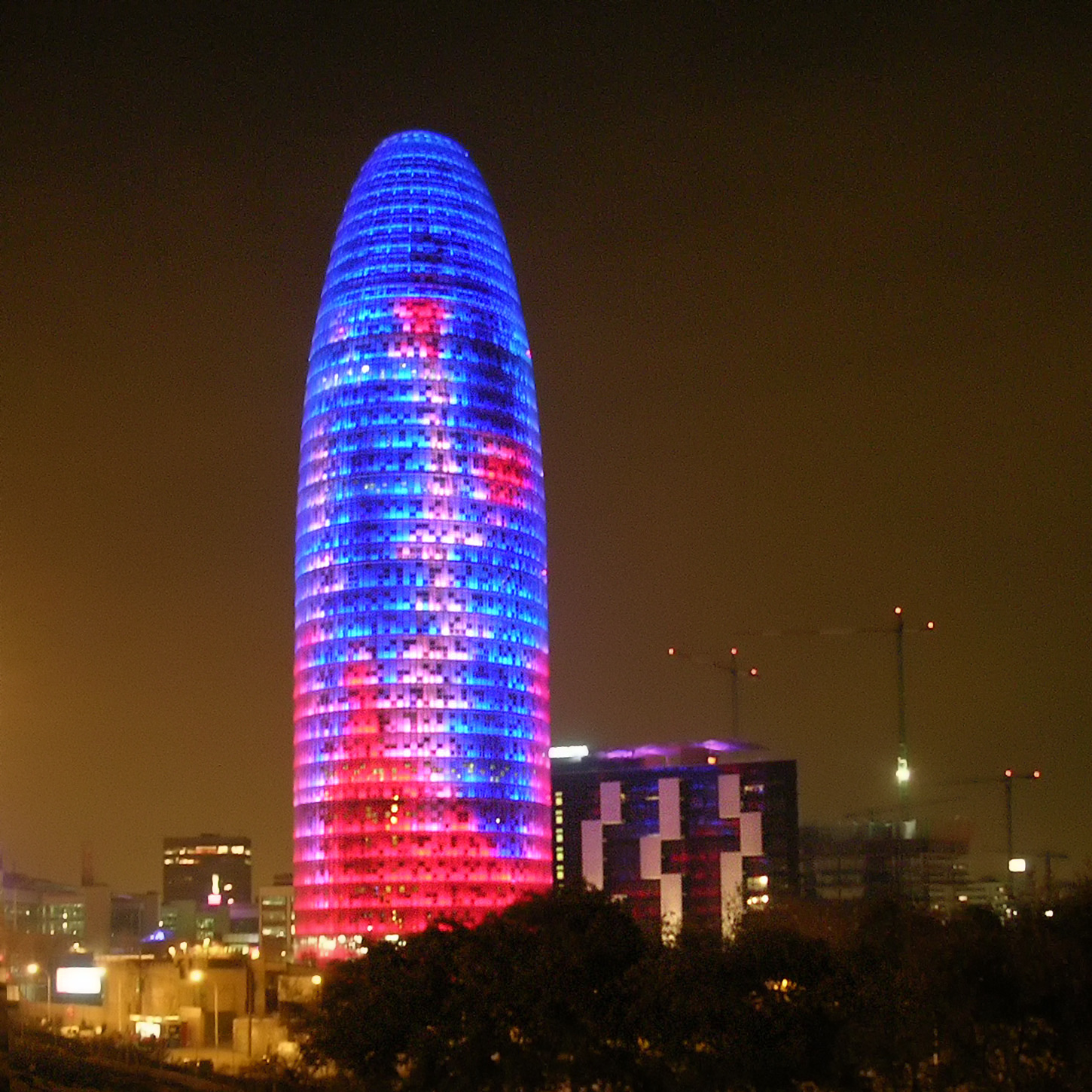
Hotel Agbar

image courtesy Wikipedia 
Barcelona's La Vanguardia newspaper reported three days ago that the Agbar Tower, an office building designed by Jean Nouvel and completed in 2005, is to be converted into a luxury hotel. The news should come as no surprise. Architecture has been responding better to the demands of tourists than those of workers or dwellers for some time now.

La Torre Agbar was specifically designed as the headquarters of the Agbar water company, hence Nouvel's geyser metaphor, but this company only occupied a portion of the building, renting the rest of its floor space out to other businesses (which is typically the case with corporate headquarter buildings, as we know from Carol Willis's book Form Follows Finance). The tenants didn't stay very long, and the Agbar company found itself alone with floor space it couldn't rent out. The building works wonders as an icon, but it obviously fails as an office building.

top floor of Agbar tower

Along comes the Hyatt Grand Hotel chain to the rescue. Their renovation plan foresees two entrances: one for hotel clients, and another for architectural tourists, which they estimate will number around one and a half million per year. Express elevators will whisk camera-toting, ticket-paying sightseers to the very top of the building, where they will be able to photograph the urban panorama of Barcelona, including the nearby Sagrada Familia temple, to their hearts' delight.

The transformation of this icon from workplace to tourist attraction provides evidence of another, much larger, transformation. Architecture has over the last decade or two become an important component of the tourism and leisure industry. It is something that we visit in our travels or take in at Saturday sports matches or Sunday museum outings. Barcelona is where this shift is most palpable. Once an important industrial city, it is now a tourist mecca. In addition to a thriving 'tourism of architecture' (Gaudí, Mies, Sert, Catalan Civil Gothic, etc.), more recently this city has also become specialized in building an 'architecture of tourism'. When completed, the Grand Hotel Agbar will probably exemplify this new typology perfectly.

2013/09/04

Product Placement / Emplazamiento publicitario


[versión en castellano sigue a continuación]

Product Placement

“Designed by Apple in California. Assembled in China.” The underside of the laptop computer I’m using to write this displays those very words alongside the model name, serial number, and safety norm compliance symbols. Funny, because until not too long ago a product usually only stated where it was made. But now it is evidently just as important—if not more important—to say where a product was designed. Could this be because the list of countries that still actually manufacture things has shrunk to a mere handful, necessitating other criteria for distinguishing one product from another? Does this mean that design is increasingly the basis upon which goods and services compete in the global economy, confirming once and for all the supremacy of form over content? Curiously, my laptop does not say which country it was designed in, but which state; California, no less. Now why would that be? What might the difference be had it been designed instead in, say, Massachusetts? Perhaps this information is intended for no other reason than to induce some California Dreamin' and good vibrations. Californication über alles.

One of the differences between architecture and industrial design, I once learned in school, is that the former is contextual and site-specific, while the latter is industrial and place-less. But this is not so. While the same Apple product can be found all over the world, the brand’s identity is very much associated with a specific culture. Indeed, global brand-names increasingly include place-names, exploiting the cachet that places—themselves often carefully branded—are able to confer. Think “Custo Barcelona” or “DKNY”.

Barcelona’s new Disseny Hub, as its name suggests, is a building whose program is none other than to assert the centrality of the Catalan capital within the contemporary design world. But curiously the Disseny Hub is not a designer-object-building, like some others nearby, but a piece of urban infrastructure designed to contain a variety of programmatic activities (design museum, the FAD design institution, a local library...) and to mediate between different neighborhoods, topographies, and  transportation corridors, most notoriously an elevated viaduct.

MBM's DHUB building comprises two main elements, one on top of the other: a large, semi-buried longitudinal volume containing offices and a vast exhibition hall, and a taller sculptural element with smaller gallery spaces and an auditorium. Reminiscent of Melnikov’s Rusakov Club in Moscow, the auditorium volume is cantilevered over the viaduct, invading public airspace. “La grapadora” (the stapler), as local residents have dubbed the sculptural element, is effectively a hood ornament for the much larger and more discreet volume below. The exaggerated cantilever was originally intended to enable a gigantic LED screen on its end-façade to be seen from the viaduct. But in the meantime the viaduct has been scheduled for demolition, an action which would eliminate the entire raison d’être of the cantilever. It seems that if a computer can exude regional vibes, architecture too can have its site-specificity taken away from it.

[originally published in Arquitectura Viva #153 under the title "Marcas y contextos / The Disseny Hub in Barcelona"]


Emplazamiento publicitario

«Diseñado por Apple en California. Fabricado en China.» La base del ordenador portátil que estoy utilizando para escribir estas líneas contiene estas palabras junto con el nombre del modelo, el número de serie y otros datos. Y esto es curioso, porque hasta no hace tanto en un producto, por lo general, sólo se indicaba dónde se fabricaba. Sin embargo, ahora parece tan importante, si no más, decir dónde se diseña. ¿Acaso lo es porque la lista de los países donde todavía se fabrican cosas se ha reducido a un puñado, lo cual exige nuevos criterios para distinguir un producto de otro? ¿Significa esto que el diseño es cada vez más la base sobre la que los bienes y lo servicios compiten en la economía global, confirmando la supremacía de la forma sobre el contenido? De una manera curiosa, mi portátil no dice en qué país se diseñó, sino en qué Estado: California, nada menos. ¿Cuá sería la diferencia si hubiese sido diseñado, pongamos por caso, en Massachusetts? Quizá el dato no tenga otra intención que transmitir el sueño californiano y las buenas vibraciones a él asociadas. Californication über alles.

En las escuelas se enseña que una de las diferencias entre la arquitectura y el diseño es que aquella es contextual, mientras que este es, en principio,  global. Sin embargo, tampoco esto está claro. Mientras que el mismo producto de Apple puede encontrarse en cualquier lugar del mundo, la identidad de marca está fuertemente vinculada a una cultura específica. De hecho, las marcas globales tienden cada vez más a incluir topónimos, aprovechando el prestigio que los lugares por sí mismos son capaces de dotar al producto. Piénsese en ‘Custo Barcelona’ o ‘DKNY’. 

Como su nombre indica, el nuevo DissenyHub de Barcelona es un edificio cuyo programa es afirmar la centralidad de la capital catalana en el mundo del diseño. Pero, contra lo que pudiera esperarse, no es un edificio-objeto de diseñador, como otros de la zona, sino que forma parte de una infraestructura urbana concebida para albergar un programa de diferentes actividades —un museo de diseño, la sede de FAD, una biblioteca— y para mediar entre barrios, topografías y corredores de transporte, entre los cuales el más notorio es un viaducto elevado. Proyectado por MBM, el edificioDHUB está compuesto por dos elementos principales, uno encima de otro: un volumen grande y enterrado que contiene oficinas y una gran sala de exposiciones; y un elemento más alto y escultural, que alberga una zona expositiva más pequeña, y un auditorio. Recordando al Club Rusakov de Mélnikov en Moscú, el volumen que contiene el auditorio se lanza en voladizo sobre el viaducto, invadiendo, sin tocarlo, el espacio público. La ‘grapadora’ —así se le conoce por los barceloneses— es un elemento escultural, una especie de ornamento de capot que cubre el volumen inferior, que es mucho más grande y discreto. El exagerado voladizo fue pensado en origen para sostener una gigantesca pantalla LED, que podría ser vista desde el viaducto. Entretanto, este ha sido condenado a la demolición, lo cual podría también eliminar, a la postre, la razón de ser del voladizo, un hecho que demuestra que, igual que un ordenador puede emanar vibraciones regionales, la arquitectura también puede seguir siendo específica, aunque sea a costa de su propio contexto.

[Originalmente publicado en Arquitectura Viva bajo el título "Marcas y contextos / The Disseny Hub in Barcelona". Traducción: Eduardo Prieto]

El País, 7.7.2013

2013/06/20

Paragraphs on Architectural Criticism


  1. Architectural criticism is a cultural activity. Culture is what distinguishes architecture from building (inasmuch as those two terms are distinguishable).
  2. Architecture is never logically or self-evidently right or wrong; only arguably better or worse. Criticism must therefore always be based on sound argument.
  3. Architectural criticism provides an interpretive reading of a work of architecture. This reading need not coincide with the architect’s stated intentions. In fact, it is much more interesting when a critical reading is different. The last thing a critic should ever be is a ‘spokesperson’ for an architect (or a politician, or a developer, or anyone else for that matter).
  4. A critic must demystify architecture without mystifying criticism in the process, testing works and if necessary challenging claims, calling bluffs, and denouncing charlatanry. Criticism must always be directed toward work and never toward persons. 
  5. A critic is a public intellectual first and foremost, defending the public interest. To this end, they must always refuse to engage in whitewashing, greenwashing, or puff pieces.
  6. A built work of architecture is best criticized post-occupancy, i.e. after it has started to perform within the life-world. Otherwise, the criticism may be overly based on speculation or theory. 
  7. Criticism, whether positive or negative, must be shared by all the ‘stakeholders’ involved in an architectural design project, including the client, planner, builder, consultants, and users (if these played a part in the design). Just as an architect has no right to claim exclusive credit for a built work when it is successful, they can similarly not be expected to shoulder all the blame for a project when it is unsuccessful. Built architecture is always a collaborative endeavour, for better or worse.
  8. Architectural criticism cannot ignore a work’s social, political, cultural and economic context; otherwise, it becomes solipsistic. But by the same token, it also can’t pass judgment based exclusively on such factors.   
  9. A building that is problematic from an ethical standpoint can nevertheless possess certain architectural qualities. Conversely, just because a work of architecture is socially and environmentally worthy of praise does not automatically entail it is architecturally praiseworthy. 
  10. Built work, precisely because it is part of a complex life-world that renders it imperfect, generally makes for much more nuanced criticism than so-called ‘paper architecture’. 
  11. Architectural criticism cannot be based exclusively on renderings or photographs of buildings. Architecture has to be experienced in situ and ‘in the flesh’ in order to be fully appreciated. This is not to say that architectural photography cannot be a subject of critical review.
  12. Architectural criticism must be seen to be independent. It cannot be directly sponsored by corporations nor can it be seen to be too much in bed with professional associations, trade unions, guilds or religious organizations.  
  13. Curating is not the new criticism, no matter how critical. While both have an effect upon the canon, they are fundamentally different; curatorial activity such as exhibitions often being a subject of critical review.
  14. Internet can be just as good a vehicle for architectural criticism as print. Neither medium is inherently more or less critical--what matters is the quality of the content.
  15. These paragraphs are neither conclusive nor certain. They constitute a theory of criticism that, like any other theory, is always up to be improved or debunked.

2013/04/25

NO a la LSP

#NOalaLSP


Spanish architecture is respected the world over, if the number of exhibitions, publications, Gaudí fans, and archi-tourists who visit this country are any indication. Yet the current Spanish government wants to de-professionalize professions such as architecture with its anteproyecto de Ley de Servicios Profesionales. If this law were to be passed, then an engineer would be allowed to design housing, schools, hospitals or museums.

The reason Spanish architecture is so respected is because its professionals are educated very rigorously; much more rigorously than in most other countries. An architectural thesis, or proyecto de fin de carrera, is not only comprised of a design and a theoretical treatise, but also a complete set of contract documents, i.e. a set of working drawings, structural calculations, details, specifications, etc. As a result, a graduate from a Spanish architecture school is competent in the art and science of building, and can be entrusted with a high degree of public responsibility. Given the complexity and density of Spanish cities, that is a good thing; not only for aesthetic reasons, but also for reasons of public safety, health and livability. We are what we build.

I have nothing against engineers. The only airplane I will set foot in is one designed by an engineer. But by the same token, I don't want my child attending a school designed by an engineer. There are good reasons for specialists in a technologically complex society. Why the current government of Spain wants to change this is beyond any comprehension whatsoever. The argument is that it will make Spanish professionals "more competitive". But judging by the record of Spanish architects who have won international architectural competitions, this argument is ridiculous. C'mon: what's the real reason?

2012/08/16

Gaudí's hanging chain models: parametric design avant la lettre?

Funicular chain model of Colonia Güell church project by Antoni Gaudí,
as exhibited at Colonia Güell Interpretive Centre.
Only the crypt was realized.

Interior view of Colonia Güell Crypt


It is known that Gaudí hated drawing and preferred to use models as design tools; especially ones made of chains hung from a ceiling, or strings with small weights attached. Through experimentation with such models, he discovered a way to use traditional Catalan masonry techniques in new, more complex ways. A chain suspended simply from both its ends results in a catenary curve that naturally distributes the static load--in this case tension--evenly between the links of the chain. When this shape is flipped vertically and the materials become brick or stone, then the static load--now compressive--is similarly evenly distributed, resulting in an optimally efficient arch. This was already known for centuries. What Gaudí did was to apply this tension-compression analogy to chains hanging from chains (or arches superimposed on arches) asymmetrically, permitting him to design a much more fluid architecture. 

Gaudí made the models of his buildings upside-down, then, using mirrors on the floor, visualized his designs downside-up. He also took photographs of these "wire-frame" models of sorts and "filled" them in with color to generate "solid model renderings", so to speak. All this has been well-documented in publications and exhibitions.

What is interesting is how, in the process, Gaudí effectively invented a kind of "parametric" design process long before the invention of the computer (let alone the development of software such as Maya or the Grasshopper plug-in for Rhino). One feature of so-called parametric design software is that it updates a complete three-dimensional digital model of a building every time any parameters are altered, allowing alternatives to be studied and compared in the search for a design that performs optimally (although to many architects who use this software it seems that the most important parameter is aesthetic form). Gaudí's hanging chains do exactly that: if a chain end-point is moved so as to enlarge or reduce, say, the floor plan in one corner, then the shape of the entire hanging chain model shifts and settles into a newly optimized catenary geometry. Of course, parametric design software does a great deal more, but at their conceptual root both of these modeling tools--one physical and the other digital--are analogous. 

Makes you wonder what Gaudí might have accomplished if he had had a computer. Or conversely, how Gaudí accomplished as much as he did without one.


2012/05/30

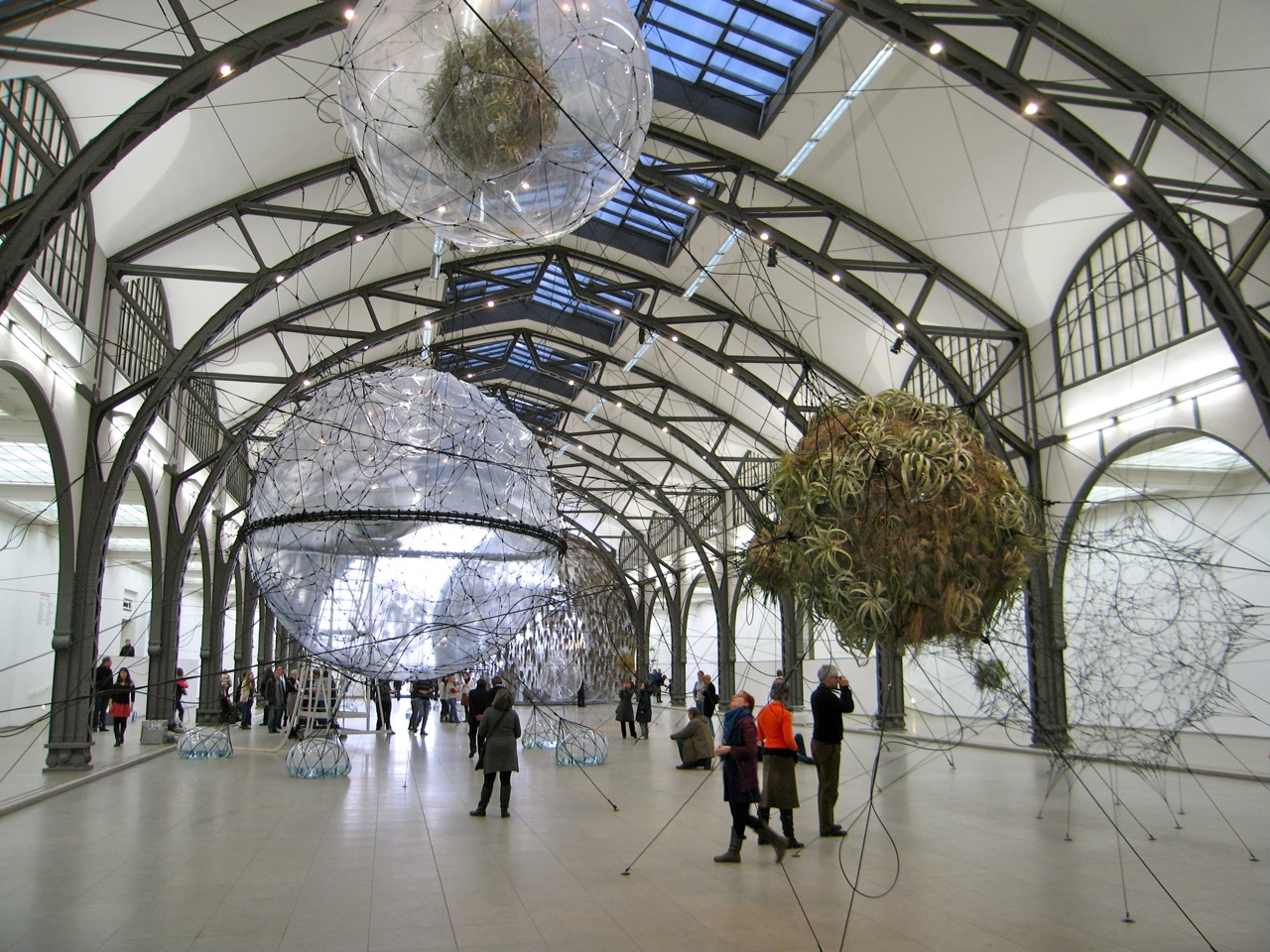
Architectural Art

Tomas Saraceno's Cloud Cities installation at Hamburger Bahnhof in Berlin 

Art galleries and museums seem to be showing with greater frequency artworks about architecture, many of them by artists who have studied architecture.

It's all very interesting, but is it architecture or is it art?

After all, art is a discipline that is completely open to every conceivable method, medium, and process. It has, for about a century now, been freed from the traditional academic categories of sculpture, painting and drawing to include conceptual art, installation art, performance art, land art, video art, photo-based art; and what we might call "architectural art" (which is arguably a form of installation art). Art is no longer restricted in terms of media, and is no longer practiced exclusively by painters or sculptors, but by artists who use multiple types of media to explore certain ideas from different angles. Architecture can be one of these ideas, and architectural construction one of those media, but if it's in an art institution, then it's art, not architecture.

There are fundamental differences between art and architecture. The most important one being that art is autonomous, while architecture has only a degree autonomy. In other words, art has an artistic freedom that architecture does not. But here we're obviously talking about architecture as "buildings", not gallery installations. As soon as an architect constructs something in a gallery (or in any institutional context involving a gallery or museum), then architecture becomes art.

When architecture occurs outside the privileged context of an art institution, however "artistic" or "sculptural" it may be, architecture will be architecture and not art.


2012/01/26

Quietly Brilliant: Nieto Sobejano Arquitectos

Centre for Creativity, Córdoba

San Telmo Museum extension, San Sebastián


Fuensanta Nieto and Enrique Sobejano are truly architects’ architects. They may not be a brand name known in ordinary households the world over, but they build fine buildings for which they have gained respect and admiration from peers. The record speaks for itself: Nieto Sobejano Arquitectos has won first place in 25 Spanish and international competitions, and come second or third in another 20. They also received the Aga Khan Award for Architecture in 2010. Not bad for a firm that’s only been around since 1999.

I meet Enrique at Nieto Sobejano’s Madrid office (the firm has a second office in Berlin) one Monday in late August, as the city is slowly returning to normal after the summer holidays. I figure the topic of competitions, and the importance of winning them, is as good as any to kick off with on a Monday morning marked by post-vacation depression syndrome. ‘Competitions are very important to us,’ says Enrique. ‘Up to now, 90 per cent of our built work has come from competitions. I say “up to now” because currently – thanks to the economic situation – Spain has far fewer competitions than it did some years ago. We opened our Berlin office as a result of winning a competition in Germany and have since won some in Austria.’ He goes on to tell me – in fluent English – that he grew up speaking German in addition to Spanish, and that he is also a professor in Berlin. Internationalize or perish: that seems to be the mantra for Spanish architects these days.


Do you believe that competitions lead to the best architecture?
Enrique Sobejano: I know of some offices that don’t enter competitions and that do very good work, mostly for private clients, with whom they enjoy a different kind of relationship. However, competitions can provide architects with certain advantages. In a competition, architects state at the outset what it is that they want to achieve. It gives them a stronger starting position in the relationship with the client. Apart from that – and even more importantly – regular participation in competitions encourages the development of a way of thinking. Competitions are conducive to intellectual development; it’s not just about getting jobs. Every new project that we do for a competition becomes a part of our ongoing research. The drawback to this way of working is that we are not linked very closely with a particular place and a particular community. We have only a few built works in Madrid. Most of our work is elsewhere, but I find that to be liberating. It frees us from local politics.

Does the competition system shape the way your office is organized?
We are not a big firm, so we don’t have one part of the office that does only competitions and another that does everything else. But we are not a small firm either, so we are often working on several competitions at the same time, especially since we opened our office in Berlin. Sometimes it’s complicated having to be in two places at the same time.

Your work seems to share certain affinities with the work of Team X and Dutch structuralism as practised by Aldo van Eyck, for instance. Is the study of architectural precedent part of your process?
Yes, we are very interested in the movements you mention, and in combinatorial ways of thinking. But ultimately we’re interested in a kind of economics of the conceptual. I’m not speaking about money here, but about not always over-designing things. We prefer to base a design conceptually on only a few building elements, and to repeat and combine these in different ways, exploring different possibilities. We are all aware that this is how life works; everything is based on modules, atoms or cells of some kind. Yet when I studied here in Madrid in the ’80s, this kind of approach was completely rejected. There were some Spanish architects from the 1950s and ’60s, such as Corrales and Molezún [designers of the Spanish Pavilion for Expo 58 in Brussels], who were also into the ideas we’re talking about – along with others, of course, including Bakema, Van Eyck and Louis Kahn.

Which Nieto Sobejano works do you consider paradigmatic, and why?
Exactly ten years ago we won the competition to build a museum and offices at the archaeological excavation site of Madinat al-Zahra, near Córdoba. That project represented a turning point for us, because Madinat al-Zahra made us aware of the incredibly rich tradition of Islamic architecture, which is – paradoxically – so contemporary. The thousand year-old geometric patterns of Islamic architecture are highly comparable to contemporary philosophical thought, to information technology and to open ended systems. And yet this museum was built very slowly, taking almost ten years to complete. Not because the builders were slow, but because archaeologists work slowly and methodically. For them we were too fast; their work is never finished. Contemporary architecture is often about speed, and we consider ourselves fortunate to have had the opportunity to build this work slowly, to really be able to think it through thoroughly. Most of our work is in the area of public cultural programmes, especially museums – buildings that receive a lot of attention. Museums have to be exemplary; fortunately, most museum directors understand this. But we are also able to meet tight deadlines: the Expo Zaragoza Congress Centre was completed in very little time, thanks precisely to an economics of the conceptual.

Your office is now completing a second museum in Córdoba, the Centre for Creativity.
Yes, the Centre for Creativity is a space for contemporary art. It is just across the river from the Great Mosque, one of the best architectural spaces in the world – a building full of lessons for architects. The system used for the Great Mosque is based on a module that is repeated, and in its present state it is also about transformation and hybridity. The Centre for Creativity is similarly related to the idea of a repetitive module, in this case one that is based on the geometry of a hexagon that has been separated into three unequal parts. A rearrangement of these fragments then becomes the pattern of both the plan, at the large scale and, at a smaller scale, the openings in the screen wall. Berlin artists realities:united collaborated on the screen wall. The surfaces of the small openings are illuminated by LEDs, and each opening acts as a pixel.

The San Telmo Museum Extension in San Sebastián, on the other hand, features a green wall.
No, not entirely. The San Telmo Museum Extension was conceived as an extension to the mountain that it is built into – Monte Urgull – as much as to the existing historical museum, which we restored. Intended to act as a buffer between the two, the extension has only a partially green façade. Plants grow in some openings, and others emit artificial light from the space between the double skin. The wall is transformative: during the day it looks more like a green façade – a landscape extension – while at night, when illuminated, it looks urban, becoming an extension of the city. Artists Ferrán - Otero worked with us on producing a standard cast-aluminium panel that could be combined in a number of ways.

Has Nieto Sobejano’s approach or process changed since its beginnings? Where do you see the practice headed in the future?
I don’t know. Some years ago we may have been looking more for the object-like qualities of buildings, whereas now we are clearly more interested in open-system geometries without a predetermined form. The museum we’re building in Graz, Austria, for example, pursues a similar line of thought to that of Madinat al-Zahra, as well as to our history museum in Lugo or the art centre in Córdoba: low, horizontal structures in which a series of patio-like openings become the defining elements of the work. I would say that our work has probably not changed all that much over the years, but it has gradually evolved. Regarding the future, as a consequence of the changing situation in the world, our field of activity might also extend outside Europe. In 2009, for example, we were among the five short-listed participants for the National Museum of Fine Art in Québec City, which OMA eventually went on to win. We are also starting to get involved in other countries, a move that is sure to introduce new perspectives to our approach, since we believe that architecture is always the result of a personal dialogue with the place – a balance between memory and invention.


As I leave Nieto Sobejano’s office and walk past the nearby Santiago Bernabéu Stadium – home of the Real Madrid football team – I am encouraged by the realization that architects can still gain international recognition quietly and through intellectual rigour, without making a lot of noise.

[Originally published in Mark Magazine #35]

2011/10/13

Quaderns #262: A Gut Reaction


Quaderns d’arquitectura i urbanisme #262 is provocatively titled “Parainfrastructures”, an invented word that is rich with ambiguity. Are we to understand this as a type of subsidiary or ancillary infrastructure operating parallel to a more official one? Or does it refer, in the sense of “paramedic”, to a temporary, quick-response, emergency infrastructure? Certainly, it suggests something more subversive, or perhaps we could say something more “underground” than ordinary infrastructure.

“Are we now completely unable to dream of antiinfrastructure?” asks John May in his introductory essay titled “Infrastructuralism: The Pathology of Negative Externalities.” His insightful and provocative critique is followed by four case studies, together comprising a section of the magazine titled “1 Essay x 4 Cases”. Of the four cases that follow, the first, Heathrow Airplot by Paisajes Emergentes, is arguably the only outright piece of antiinfrastructure: it proposes to prevent the expansion of Heathrow Airport by positioning a series of large Pink Floyd-like balloons to occupy flightpaths so that they literally stand–or float–in the way of progress. The other three cases (Brockholes Wetland Visitor Centre by Adam Khan, Lolita restaurant by Langarita-Navarro, and Nagelhaus by Caruso St John), all of which have something to do with highway infrastructure, relate more tenuously to May’s thesis. Significantly, the texts accompanying each of these four works are architects’ project statements; not critical reflections. The same goes for the works included in the Observatory section at the end of the magazine. I guess architecture critics need not apply here.

The sections in the middle, “Archive 1971”, “3 Essays x 1 Case”, and “Guest” are much more coherent and watertight. The Archive section features a different year in every issue; a sort of blast-from-the-past. In this issue, the year 1971 is featured, and includes an interview with José Miguel de Prada Poole followed by historical research and firsthand accounts of the building of experimental inflatable structures. 3 Essays x 1 Case looks back at Girona-Costa Brava Airport, a building which has had its share of ups and downs during its lifetime. The instigation to look back and reflect on past work is one of the most significant turns this edition of Quaderns has taken. Architecture takes on a life of its own when it becomes inhabited; a reality that can sometimes be stranger than fiction. For an architecture magazine to critically reflect back on the real life of buildings, and not just ones idealized in design intentions, is praiseworthy. The conduciveness of architecture to a better shelf-life might just become a little more lubricated.

Continuity can be seen as another quality of this edition of Quaderns magazines. Each issue begins with a review of the last one and ends with a segue into the next, which in this case is preservation. A debate, if it were (only) to erupt, is well served by the weaving of a continuous thread through consecutive issues of a magazine. And provoking debate is exactly what magazines such as Quaderns should be doing.

[Originally published at http://quaderns.coac.net/en/2011/09/reaccions-262-gomezmoriana/ ]

2011/03/26

Pop Architecture

Ordinary, everyday objects--that's what most architectural sobriquets refer to. A gherkin, a paperclip, a typewriter, a stapler, mushrooms, milk cartons, cereal boxes, dildos... These kinds of endearing associations create a pop-cultural world parallel to Claes Oldenburg and Coosje van Bruggen's, whose inflated, oversized banal objects are exactly what the "untrained eye" seems to see in many buildings.
"La macchina per scrivere" (the typewriter), Rome.
"La grapadora" (the stapler) by MBM, Barcelona
"De paperklip" (the paper clip) by Carel Weeber, Rotterdam.
"Las setas" (the mushrooms) by Jürgen Mayer H., Seville.
"El tampax" (the tampon), by Toyo Ito, Barcelona
"La pedrera" (the stone quarry) by Antoni Gaudí, Barcelona.
La colmena (the beehive), by Taller de Arquitectura, Barcelona
La gasolinera (the gas station), by Viaplana, Piñon, Miralles, Barcelona
"The gherkin" by Foster, London
La râpe à fromage (cheese grater), Roger d'Astous & Jean Paul Pothier, Montreal
La chute à linge (laundry chute) by Moshe Safdie, Montreal (photo courtesy nwaonline.com)
One of many "milk cartons" by IKOY, Winnipeg


"El Toblerone", Almería. Image courtesy salvemoseltoblerone.org

2010/11/29

Interview with Peter Eisenman

[This is an excerpt of an interview I conducted with Peter Eisenman in Santiago de Compostela in May 2010. The full interview is published in KLAT magazine #4, which can be ordered here]

Rafael Gómez-Moriana: I can’t help noticing that you give a lot of interviews.

Peter Eisenman: They are all on different subjects. In addition to my work as an architect I write, I lecture, I teach, so I end up giving interviews about everything from football to theory. Perhaps the least interesting topic for me is architecture. Architecture is basically boring as an interview subject.

RGM: Indeed, you’ve been interviewed quite a bit on the subject of politics.

PE: That’s because many of my clients are to the right-of-center politically, so interviewers occasionally try to get me to say right-oriented things.

RGM: Well, I hate to disappoint you, but most of my questions have to do with architecture; specifically the City of Culture of Galicia. Is this the most important project of your career?

PE: Now, the City of Culture is not boring, I am very excited by the buildings. It is certainly one of my most important projects.

RGM: It's currently the largest construction site in Spain, if I’m not mistaken, and probably one of the largest in Europe.

PE: It’s a million and a half square feet under cover,  which makes it larger than the Getty Center. So yes, it's a very large project.

RGM: Does building in Spain differ very much from building in the USA or Germany? Some like to say that Spain is different.

PE: All countries have different aspects. Take Europe and America. There is much more concern in Europe for public space than there is in the United States. In the USA, public space is mainly controlled by developers. You could not do a public project of this scale on public land in the United States; it would be taken up by developers. In Germany, the Holocaust Memorial sits on a prime piece of real estate in the center of Berlin. This would be impossible in New York because of real estate speculation. Europeans’ concern for public space manifests itself in the media. Every time I visit Spain, Germany or Italy there are requests for interviews with the press and television. Architecture is good media in Europe because cities are an important part of European culture. Galicia is different, though, because there is a certain longing for a return to the regional language and customs...there’s a certain “not wanting to be in the world”. Manuel Fraga is a very cultured and sophisticated man who, when he was president of Galicia, really wanted to do something good for Galicia. He didn’t want to do what Franco did at el Valle de los Caídos. He wanted to contribute to the culture of this place, or create a culture of this place. When he was Spain’s Minister of Information and Tourism he created the Paradores, and as Galicia’s president he had the idea for the City of Culture architectural competition. When we won, Fraga was insistent the project was going to be built, and built well. He worked very hard to do it. In Germany it was also a struggle to build the Holocaust Memorial, but there was general agreement that it should be built. Nobody questioned that. The disagreements were regarding what it should mean, how it should look, etc. There was more of a political consensus in the German parliament. Spain’s politics are more polarized. The politics in Spain are different, and you feel that when you're doing architecture here. Nobody has ever built a project of mine as well as these buildings are being built in Galicia. Yet we still find ourselves having to educate the people of Galicia about this project.

RGM: But isn't that somewhat ironic, since there’s a strong landscape metaphor in the City of Culture? Landscape is something the regional culture here values very dearly, I would think. I wonder if you could comment about landscape in architecture, because lately we're seeing a lot of architects likening their projects to mountains, rivers, glaciers and crystals rather than to architecture per se.

PE: Nature is never used as a metaphor in my work. Rather, the work is concerned with a very fundamental architectonic project. The philosophical background to the work is the metaphysical dialectic: the relationship between ground and object. That has been a dominant discourse of current thought, specifically poststructuralist French thought, which has argued that there is a problem in the hegemony of vision. It manifests itself in the figure in the frame in painting. In architecture this discourse is largely a visual one. Since 1978 my work has attempted to confound the relationship between ground and figure, so that figure becomes ground and ground becomes figure. That's why it is so difficult to photograph these buildings: they're not objects. They’re not “image buildings”. They are experiential buildings; actual buildings for people, not metaphors. The innate idea in the City of Culture is that it is a hillside that has erupted and heaved up from the Monte Gaiás, that it is a pre-existing object. 
...