Criticalista has moved – you will be redirected to http://criticalista.com

Criticalista: tourism
Showing posts with label tourism. Show all posts

2014/02/28

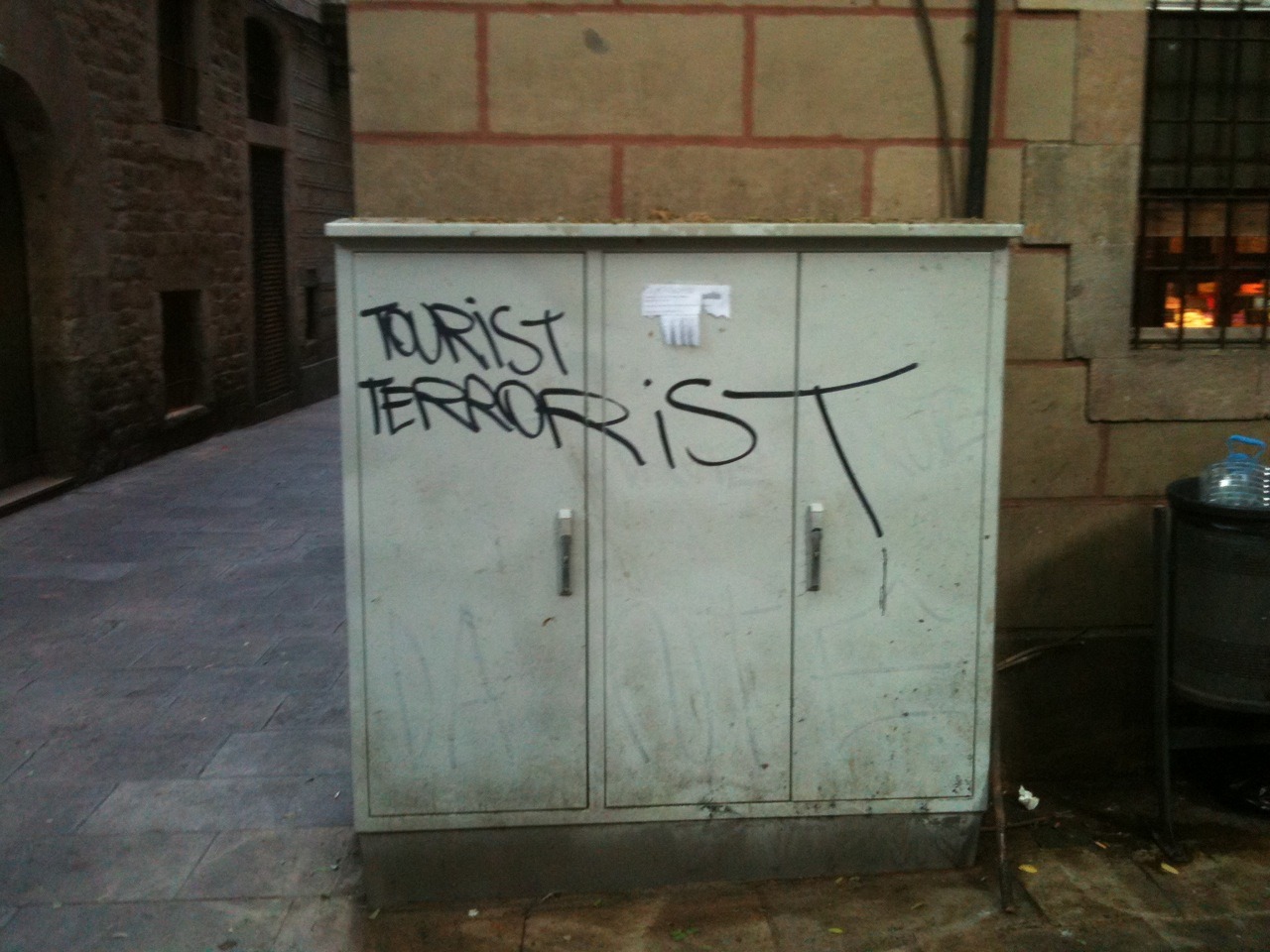
Tourism versus Terrorism


(courtesy photoree.com user jrbrubaker)
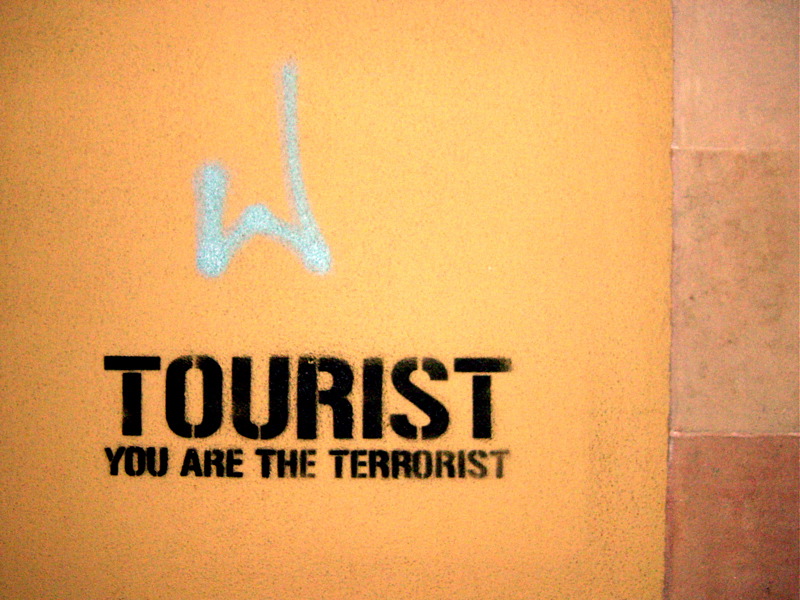
(courtesy tumblr.com user noahi)
¿Is tourism a form of terrorism?

Some Barcelonins seem to think so. All over the city --especially near tourists sites-- slogans such as "tourism = terrorism" or "tourist, you are the terrorist" can be spotted stenciled or spray-painted on urban surfaces. Interestingly, as any image search will confirm, these graffitis are themselves a favorite subject of photography and commentary by tourists.

Among the very few industries that has actually grown during the now seven-year long economic crisis in Spain, tourism is increasingly dividing Barcelona's citizens. Those whose livelihood depends upon tourism (including myself, since I earn my living teaching courses to foreign students participating in study-abroad programs together with writing articles about architecture, which is ultimately a tourism commodity) are willing to put up with the inconvenience of busloads of gawkers blocking sidewalks and causing traffic congestion. Besides, I also like to travel abroad whenever I have the time and of course some spare pocket money to spend.

But tourism is viscerally despised by others who critique it as a non-productive industry offering only temporary, part-time seasonal work under usually humiliatingly exploitative conditions; a sector which is controlled by a powerful lobby that is increasingly setting the political agenda of our governments. These detractors see every local family business that is being driven out by a Starbucks or a MacDonald's; every residential dwelling that is converted into a tourist apartment, thereby driving up rents; and every Asian or African immigrant working for peanuts in a restaurant, as being squarely the fault of tourists.

Tourism is big business, and big business is unscrupulous and utterly devoid of ethics --we know that much already. But is it equivalent to the violent assassination of innocent people in order to instill a climate of fear in the population?

A group of 'terrorists' admiring the architecture of Casa Vicens by Antoni Gaudí

2014/01/12

Power, Corruption and Architecture

Photo courtesy ElMundo.com
Transparency International released its annual report some weeks ago, and this year's corruption perception index, which ranks 177 countries from least to most corrupt, lists Spain as having dropped from position 30 to 40. In just one year.

Yes, you might well ask, but what does architecture have to do with all this?

Well, the biggest corruption scandal of them all, the Bárcenas affair (after Luís Bárcenas, the imprisoned former treasurer of the right-of-centre Partido Popular / PP, which governs Spain nationally as well as regionally in 11 of its 17 Autonomous Regions and locally in the majority of its municipalities), is about supposed illegal party funding during nearly two decades, mostly by construction companies and real-estate developers, who, in exchange for "donations" to the PP party, received favorable consideration by PP-led local or regional governments in the allocation of large public works contracts, or were granted favorable changes to land-use zoning bylaws when building private developments.

The whole racket began in 1990, but it went into high gear in 1998, when land law reforms passed by the Aznar-led PP majority government to facilitate zoning changes stimulated a huge boom in private real estate development that would last over a decade and that, upon bursting, would cause a disastrous economic crisis that is still on-going and seemingly never-ending. The construction boom's huge urban expansions required new infrastructure and public buildings, which in turn meant, of course, lots more opportunities to raise cash for the PP coffers. During the boom, the PP's slush fund was so large that Luís Bárcenas regularly handed out "bonuses" --envelopes containing large sums of cash-- to the party brass, including allegedly Mariano Rajoy, the current prime minister of Spain. Catalonia's ruling right-of-centre CiU party is embroiled in a similar scandal, the Palau case, in which contractors were allegedly systematically charged a 3% fee in the allocation of public works contracts.

Judges and journalists who have tried to investigate corruption networks, such as Judge Baltasar Garzón's probe into the "Gürtel" scandal or the Catalan digital newspaper Cafè amb Llet's uncovering of sleaze in Catalonia's public health system, have been either removed from office or sued for defamation, while a great many politicians accused of corruption are still in office. Corrupt politicians and royalty are defended, ironically, by none other than Spain's special "anti-corruption" prosecutor's office. Talk about impunity.

But what does architecture as distinct from construction have to do with all this?

The fact is that the real estate and public works boom of the 2000s coincides exactly with the period in which Spanish architecture was heralded around the world as exemplary. "Good architecture" thus became an unwitting byproduct of --if not a cynical smokescreen for-- large-scale political corruption. As long as critics, curators, and archi-tourists were gushing over all the fabulous new buildings in Spain, then maybe the hundreds of millions of euros of tax money that was being diverted into the pockets of politicians wouldn't be noticed. Or worse yet--this being the land of the picaresque por excelencia-- maybe such wrongdoing would even be tolerated if it meant Spain was being celebrated in the global spotlight, which it certainly was. The architecture boom was such a good party while it lasted, that nobody wanted to entertain the possibility that architecture, known to march hand-in-hand with power, might also be marching hand-in-hand with XL-size political corruption.

Many ordinary Spaniards are now sickened, not only by negative effects of the construction boom (urban sprawl, thousands of empty buildings, unemployment, forced evictions, polarization of wealth, disappearance of the middle class, etc.), but also by the perception that architecture was somehow either directly or indirectly complicit with the boom. This feeling of betrayal is especially significant because Spanish architects generally enjoyed a high level of citizen respect until recently. Before the death of Franco in 1975, architecture students were an important contingent in the pro-democracy student movement, and a number of architects played leading roles in neighborhood-association struggles to improve living conditions in Spanish cities.

Spanish architecture was thus identified with an incipient democracy movement at one time. Corruption, on the other hand, directly undermines democracy, and it is interesting to note a change that occurred in Spanish architecture from the end of the Transition period to the boom-years of the late 90s and 2000s. Whereas up to the 1992 Olympics most public works projects concentrated on renovating public spaces and building new public institutions (schools, sport facilities, city halls, etc.), usually at the neighborhood scale; after 1997, the year that the Bilbao Guggenheim Museum opened, a new typology emerges that we might call an "architecture of tourism": cultural facilities that are so large, they could only have been designed with hordes of tourists in mind as the principal user-group. Alongside these publicly financed tourism mega-projects, private real-estate development built primarily for purposes of speculation began to spring up. Generalizing grossly, we could say that the pre-Guggenheim period's architecture had the improvement of the lives of citizens as its priority, while most of the building undertaken during the post-Guggenheim boom years now ultimately had tourists and foreign investors in mind, in addition to voting citizens of course.

The more the construction industry profited (and the more they donated to political parties such as the PP or Catalonia's CiU party), the more Spanish architecture excelled in recognition and won international competitions. Coincidence? Or is it merely a case of having to take, as it were, the good with the bad (and the ugly)? The boom is also the period during which a significant number of prestigious Spanish architecture magazines went to global distribution, and when many celebrated architects from abroad started building in Spain and vice versa. Numerous architectural master's programs aimed at foreign architecture students appeared at the same time that many Spanish architecture students and academics went abroad to study or become leading figures at some of the most prestigious architecture schools. Thus, even architectural theory and criticism "boomed" alongside the construction and architecture boom, gaining increasing global recognition.

Spanish architecture thus shifted from mainly local concerns to chiefly global concerns. Accordingly, attention shifted from the concerns of citizens to those of tourists, consumers of global media, international financial speculators, and architectural academia. But all this changed from one day to the next when Spain's feverish construction bubble suddenly burst in 2008.  Architects themselves were not only suddenly out of work, but were also suddenly shunned by a society that until then had regarded them as heroes. Unfair scapegoats? Perhaps. In any case, a profession that was societally respected and internally bonded was now coming apart, both literally and metaphorically. Since the great crash, there has been almost no work, no income, and no optimism. A very high number of architects have been forced to move abroad, some as far as the Americas or Australasia. Interestingly, at this moment more US architecture schools are headed by Spanish architects than ever before (a group colloquially referred to as "The Spanish Armada").

Back in Spain, meanwhile, a law has been tabled to "liberalize" the profession and make it more "competitive" (we all know what that word really means). Enrollment in architecture schools is way down, while paper architecture, collectives, collaborating (once again) with activist groups and neighborhood associations, and un-solicited architecture are up, as are "alternative" spatial practices that approach art. Such alternatives to traditional practice, even if these put yet less bread on the table, show the inventiveness and persistence of Spanish architects, who are some of the best-educated in the world.

We are now being told that the crisis is over, and that it's all going to get better from now on; that our sacrifices are finally bearing fruit. While we are being told this, the majority PP government is passing an anti-protest and hence anti-democratic "Citizen Safety Law" the likes of which have not been seen since the Franco era. Another law designed to protect coastal construction is being reformed to facilitate construction on those few remaining stretches of coastline that have not been destroyed already, while another law is being entertained that would provide an instant Spanish (and hence EU) passport to anyone "investing" half a million euros in Spain; a law obviously aimed at reducing the current surplus of approximately 800 000 apartments. Perhaps the PP ultimately wants to kick-start another con-struction boom; a re-ron. Only this time, the spectacular hotel casinos for both tourist consumption and real-estate speculation in one (giving a whole new meaning to the term "multi-use building") will be built by global developers and their brand of global architects. The Spanish government has already shown that it is willing to bend over backwards (which in Spanish translates as "bajar los pantalones", or lower the trousers) in order to meet the demands of developers, such as easing laws concerning money-laundering, smoking in public buildings, foreign work visas, and of course land-use zoning. What the failed negotiations over EuroVegas reveal is just how low the Spanish government is willing to go in lowering its trousers. The only one of Sheldon Adelson's demands that it couldn't meet was a guarantee that future governments would not recede on the final agreement. A democratically elected government cannot, of course, ever agree to such a condition--only a dictator is in a position to do so.

Although EuroVegas thankfully fell through in the end, the eagerness with which this project was embraced by ruling politicians paints a dismaying picture of Spanish architecture in the coming decade or two. It will likely become two-tiered and highly polarized, just like Spain itself, with a handful of local architecture collectives designing food banks, emergency shelters for the homeless, and Single-Room Occupancy dwellings for NGOs, while a handful of superstar "developer-architects" (with names like BIGGUS DICKUS, Co-opted Himmelb(l)au, OMG, and Frankly Garish) will probably be brought in to design private hotels, casinos, tourist apartments, gated communities and luxury marinas. There will be very little in the way of museums, since so many have been built in the last decade that there is little to no money left for their collections. In fact, public work will all but disappear, since there is little public money anyway, growing public opposition to these kinds of projects, and since it is no longer as profitable a method for filling the coffers of ruling political parties. But the PP party has already found another way to profit from the public sector: privatizing it by selling off public institutions such as Spain's regional health-care or education systems to their cronies.

This time around, "architecture" will have little to gain.


2013/11/20

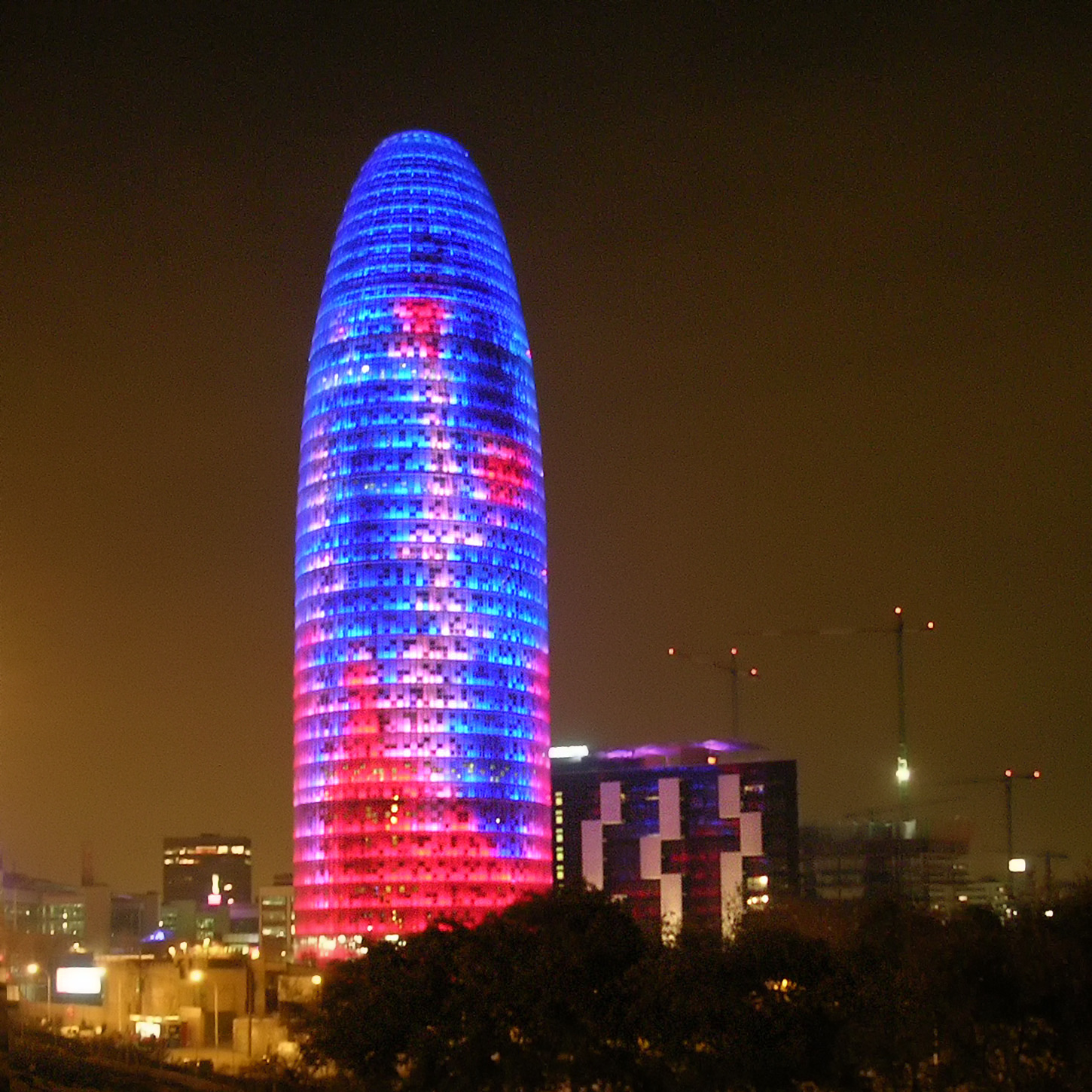
Hotel Agbar

image courtesy Wikipedia 
Barcelona's La Vanguardia newspaper reported three days ago that the Agbar Tower, an office building designed by Jean Nouvel and completed in 2005, is to be converted into a luxury hotel. The news should come as no surprise. Architecture has been responding better to the demands of tourists than those of workers or dwellers for some time now.

La Torre Agbar was specifically designed as the headquarters of the Agbar water company, hence Nouvel's geyser metaphor, but this company only occupied a portion of the building, renting the rest of its floor space out to other businesses (which is typically the case with corporate headquarter buildings, as we know from Carol Willis's book Form Follows Finance). The tenants didn't stay very long, and the Agbar company found itself alone with floor space it couldn't rent out. The building works wonders as an icon, but it obviously fails as an office building.

top floor of Agbar tower

Along comes the Hyatt Grand Hotel chain to the rescue. Their renovation plan foresees two entrances: one for hotel clients, and another for architectural tourists, which they estimate will number around one and a half million per year. Express elevators will whisk camera-toting, ticket-paying sightseers to the very top of the building, where they will be able to photograph the urban panorama of Barcelona, including the nearby Sagrada Familia temple, to their hearts' delight.

The transformation of this icon from workplace to tourist attraction provides evidence of another, much larger, transformation. Architecture has over the last decade or two become an important component of the tourism and leisure industry. It is something that we visit in our travels or take in at Saturday sports matches or Sunday museum outings. Barcelona is where this shift is most palpable. Once an important industrial city, it is now a tourist mecca. In addition to a thriving 'tourism of architecture' (Gaudí, Mies, Sert, Catalan Civil Gothic, etc.), more recently this city has also become specialized in building an 'architecture of tourism'. When completed, the Grand Hotel Agbar will probably exemplify this new typology perfectly.

2013/09/01

Architecture Road-Tripping: Marseille


Earlier this August, I went on a roadtrip through southern France and spent two nights in l'Unité d'Habitation in Marseille, by Le Corbusier, together with my partner in crime. This landmark building has a small hotel in it--named Hotel Le Corbusier, of course--that is reasonably priced and has plenty of free parking, so I thought: hey, why not go there? Besides, I always wanted to visit the French city most diametrically opposed to Paris: Marseille is not full of snobs, has almost no luxury stores, it is not overrun by tourists, and its urbanism is chaotic while its architecture is modern, which is how I like my cities. Don't get me wrong: I have nothing against Paris. "I have plenty of Parisian friends". So we set out in the morning from Barcelona, a crime-ridden Mediterranean port city, for Marseille, another crime-ridden Mediterranean port city.

Road trips are the best way to travel and to get to know a country. No advanced reservations are required, there's no airport stress, and security checks are only a matter of really shitty luck. The land, perfectly framed by the windshield, can also be smelled, touched (during pit stops), and heard. There is much more interaction with local people, local customs, and local cuisine, and the lay of the land becomes apparent even through such trivial minutiae as local driving habits. And to say nothing of re-fueling: the true measure of the level of civilization of a nation lies in the quality of the food that is to be had by the proverbial side of the road. Never mind the number of Michelin stars or Restaurant Magazine rankings: those don't reflect the larger picture in the least (London comes after Paris in a ranking of European cities by number of Michelin stars. Need I say more?). The architectural analogy might be: the number of Pritzker prize winning architects a country can brag about having does not necessarily reflect the general quality of that country's architectural landscape. Roadside architecture, by which I mean built stuff you come across by surprise, in a random and unplanned manner, says much more about the current state of architecture in general (with all due respect to my Pritzker prize-winning friends).

The thing about a roadtrip is that it's not the destination that counts--it's the road itself. The destination is just an excuse. The Unité d'Habitation is really just a pretext to hit the road, Jacques. This provides the advantage that upon arrival, the trip will still be less than half-over, and we might even be pleasantly surprised by the building (which, in fact, we were).

Only one thing disappointed about the Unité: its location. To be precise, severe difficulty was encountered, after arriving and getting settled in (by which time it was evening), in finding a bar to quench our thirst. L'Unité's own restaurant (named Le ventre de l'architecte--the Belly of the Architect, no less) was closed for August holidays and the hotel's own café had just closed, so we had to venture out of the incredible hulk of a building that is the Unité. To our disappointment, the neighborhood outside the building was dead. What little there was in the way of a commercial fabric was firmly fermé, either for holidays or because it was...nine o'clock in the evening(!). I mean, it's known Le Corbusier was an uptight Swiss Calvinist, but this is ridiculous. After two hours of walking around (I guess we should have driven), and as the thirst became unbearable, I started to miss Barcelona.

The next night, it was decided that drinking a bottle of wine on the roof-terrace of the Unité would be a much better idea than looking for some nightlife in this dull end of town. Le Corbusier would undoubtedly approve of this. And this is when the best thing that happened on the roadtrip happened: as we looked for a garbage receptacle or a recycling bin into which to toss the empty wine bottle and call it a night, we noticed that a group of people was seated on a terrace at the top of some stairs that were off limits to non-residents. I approached and asked where I could dispose of my empty bottle properly, and the answer was: "Ici, sur la table, along with the dozens of other empty bottles. You two look like you could use a refill." What followed was a pleasant evening of wine-lubricated conversation with a dozen or so residents of the building, only one of whom was actually an architect. I learned more about the building from these residents than I have from all the texts I've read about it: the community association is apparently very active, and the rooftop gallery space a success. Most importantly, these residents seemed to be enjoying each others' company and happy to live where they live. If that's not the best measure of the success of a work of architecture, then I really don't know what is.


The Unité may have been merely an excuse to embark on a roadtrip, but it turned out, in retrospect, to have been a highlight, albeit not exactly for the reasons we expected.

Mailbox in one of the rues of l'Unité. Brad Pitt??

2013/08/20

La Grande Motte Revisited


I first saw La Grande Motte in the summer of 1978, more than a decade before I would graduate from architecture school. Back then, the town left an impression on me for its large pyramid-shaped concrete buildings, and for the fact that the beaches had scores of young women who went topless; a bit of an eye-opener for a 14 year-old male just landed from North America. 

In retrospect, I must have been very distracted by the peaches on the beaches, because more recently, upon revisiting La Grande Motte (this time accompanied by a female architect-friend), the place looked completely different to me, even though, at its core, it has changed little during that period. Clearly, what seduced me this time around was the architecture.

I mean, here we have an example of a late 20th-century new town with public spaces that are civic, dignified and human life-affirming and whose buildings are designed to contribute to an overall harmony; to something greater than the mere sum of the parts. La Grande Motte is living proof that it is possible to design a humanly-scaled, walkable, cyclable, and architecturally sophisticated new town without resorting to, say, the pre-industrial nostalgia of so-called New Urbanism. (Perhaps I'm being nostalgic too, but at least it's nostalgia for a period I have lived through.)

A small civic square on one side...
...on the other side, a courtyard garden

Architect Jean Balladur master-planned La Grande Motte in the mid-1960s as a place where the Northern European middle-class, which at that time was beginning to frequent Spanish destinations like Torremolinos or Benidorm en masse, could vacation closer to home, and in an architecturally more sophisticated setting. Emphasis was clearly placed on creating an overall sense of harmony akin to that of traditional vernacular architecture, but with modern materials and expression. 

La Grande Motte does not banish commerce, signage, sun shades, or Hello Kitty beach towels hung to dry over a balcony handrail. This is no Communist vacation camp. Rather, these kinds of elements of "individuality" are subtly veiled behind differently patterned perforated concrete screen-façades, which vary playfully but also consistently from building to building. 

Ah, yes, that age-old conundrum of finding a balance between overall urban identity and individual architectural identity. Interestingly, no building is privileged over any other at La Grande Motte. There are no singular "landmark" buildings by famous architects whose task is to somehow compensate for a sea of surrounding mediocrity. A similar lack of hierarchy occurs in the urban plan: No rows of sea-fronting buildings blocking second-rate buildings in-behind. 

Since 2010, La Grande Motte has been officially recognized as French 20th-century patrimôine. But it deserves to be celebrated outside of France too, because I doubt many other examples of new-town urbanism from the last half-century are this successful still to this day.


2012/12/19

Garden and Gaffe: A Hotel by Jean Nouvel


“The city is like some large house and the house in turn like some small city”
-Leon Battista Alberti

If there is one type of "house" that comes closest to Alberti’s “small city”, then surely it is the hotel. Like a city, a hotel is comprised of both private “residential” space (in this case temporary residences) and relatively public functions; the private realm making up the representative bulk and consisting of largely repetitive units while the more public lobby, conference spaces, restaurant, and so on are monumental, singular spaces of representation. The ultimate mixed-use building type, a hotel is a place where guests stay for a variety of reasons, be it a travelling sales rep hoping to strike a business deal, illicit lovers having an affair, criminals evading the police, academics at a conference, or spies on an intelligence-gathering mission. Anything can and everything has happened in hotels: Watergate, John Lennon and Yoko Ono’s Bed-ins for Peace, Dominique Strauss Kahn.

It is no surprise, then, that the hotel has become in recent times one of the most architecturally reinvigorated types of buildings. The drab, beige hotel of the nineteen seventies and eighties, where sameness, familiarity and the offer of a cozy “home away from home” was the ideal, is seemingly a thing of the past. Hotels have instead become places where people seek a memorable experience that is precisely different from the familiarity and routine humdrum of home. As an “experience” space available to a majority of people, the hotel can also be seen as a democratization of the pleasure palaces of the aristocracy of previous centuries.

The Renaissance Barcelona Fira Hotel by Jean Novel and Ribas & Ribas is, like many palaces, characterized principally by a garden, that most sensuous space of pleasure and temptation since biblical times. This garden, however, climbs up a 26 story high atrium space that is completely open to the exterior on one of the sides of the tower, which forms a “U” shaped floor plan in which the rooms are accessed by garden-facing galleries that are open during three seasons of the year, and that are separated from the garden in winter by means of transparent roll-down barriers.

A single staircase climbs up the atrium along a different trajectory at each level change, connecting galleries as well as bridges, platforms, and a over a hundred planter boxes containing ten different varieties of palm trees and other plant species. It is a delirious, seemingly endless space that would make Giovanni Battista Piranesi proud, and which redefines the late-modern hotel atrium made famous by architect-developer John Portman.

It is the exterior openness of this atrium that sets it apart from any of  John Portman’s, however. In this atrium, there is no wall-to-wall carpeting, no chrome, and no air conditioning. Instead, there is a gentle breeze and the sounds and framed view of a city beyond. The leaves of the palm trees move in the breeze, and the hotel rooms open directly onto an exterior garden and not into a long, dim, anonymous corridor, making it tempting for guests to leave the door open when in their rooms.

Unfortunately, however, the theme of “palm tree” has been taken by its architect just a little too far. The palm tree-shaped windows of most of the rooms are gimmicky and goofy. A gaffe. Those windows are precisely why it’s a good thing the doors of the hotel rooms open directly onto the memorable garden--and city--outside.

2012/12/12

Strange Bedfellows

Left: Construction of Instant City, Ibiza, in 1971 (photo www.domusweb.it)
Right: Hotel Algarrobico, Carboneras, Almería, 2010.

The image at left shows the construction of the "Instant City" during the congress of the International Council of Societies of Industrial Design (ICSID) of 1971, which was held at the Hotels Cartago and Galeón in Ibiza (visible in the background). The Instant City is currently the subject of a celebratory exhibition at the Macba (Barcelona Museum of Contemporary Art) titled "La utopía es posible."

The image at right shows the infamous Hotel Algarrobico, construction of which began in the early 2000s within the boundary of the Cabo de Gata-Níjar Nature Park--a UNESCO Biosphere Reserve since 1997. Although it has repeatedly been ordered to be demolished by the courts, this never completed behemoth is still standing to date. As part of a 2007 Greenpeace "action" to raise awareness, the words "hotel ilegal" were painted in large four story high letters on its sea-facing elevation. 

The two hotels in these images, whose architecture is not entirely dissimilar, are separated by a distance of only four hundred kilometers and a timespan of only a few decades, yet one is celebrated as the site of an optimistic event that marked a milestone in the cultural modernization of Spain, while another has become the very symbol of political corruption and reckless development in this country. Utopia and dystopia: strange bedfellows indeed.

2012/05/17

Architourism

Tourists at the Mies van der Rohe Pavilion in Barcelona
Tourism is the only 'industry' in Spain that is not downsizing in the current (well, actually it's been five years now) economic downturn. On the contrary, the number of visitors to Spain has been growing steadily. And it's not beach tourism that's growing, but urban-cultural tourism, which includes architecture. In Barcelona, the Gaudí industry is doing molt bé.  Even the Mies van der Rohe Pavilion seems to be receiving more visitors than before.

But while architecture as cultural tourism is doing better than ever, architecture as building is in the doldrums in Spain, a country with a high number of living (not to say 'working') architects who are internationally respected. Something is surely wrong when an entire generation of talent sits idle while the talent of previous generations is increasingly consumed like fast food. But then again, it's a perfect sign of the Zeitgeist, isn't it?


2009/08/07

Visitant / Local II

"The beach is the only space of enjoyment that humans have found in nature." - Henri Lefebvre

2009/03/17

Us and Theme

If Venice, the Wild West, or Asia can be themes for parks, casinos, or hotels, then why not contemporary architecture? "Theming" has, after all, been a part of architecture for quite some time, as the interesting collection of essays Variations on a Theme Park, edited by Michael Sorkin (New York: The Noon Day Press, 1992), makes evident. Even Hadrian's Villa in Tivoli can be seen as a theme park of sorts, so architecture is on some level intrinsically bound with the very idea of theming.

What is significant about Hotel Puerta de América in Madrid, in which each of its 14 levels is by a different architect or designer, is that it is a theme hotel whose theme is precisely contemporary architecture and design. Of course, merely having interiors on different floors designed by different architects or designers does not necessarily a theme hotel make. What makes Hotel Puerta de América one is the fact that clients choose which designer they would like to sleep with when they make a reservation.

In most hotels, choice is normally limited to amenities, degree of luxury or size. But here, the design--specifically the designer--becomes the object of choice.

There are lots of theme hotels designed by well-known architects and designers. But the themes of these hotels are "Santa Fe" or "Swan Lake": the architecture may be themed, but the theme in such cases is not architecture itself.

Curiously, the Hotel Puerta de América does not bill itself as a theme hotel. The word "theme" is absolutely nowehere to be found in the hotel's promotional literature or on its website. The prices are also quite a bit higher than a "normal" theme hotel. Perhaps this explains why.

Oh, in case anyone is wondering, the rooms with the highest occupancy rate are Zaha Hadid's.

2008/11/02

Welcome to the Hotel Barcelona

In case anyone hasn’t noticed, Barcelona is in the tail-end of a hotel construction boom. And Barcelona being “Barceloooooonaaaaaa” means, of course, that these have to be designer hotels. Designery types such as Richard Rogers, Dominique Perrault, Carlos Ferrater, Oriol Bohigas, Juli Capella, Enric Ruiz Geli, Oscar Tusquets, and Ricardo Bofill (to name only some) all have a four- or five-star hotel in the works if not recently completed.

Interestingly, a number of new hotels are high-rise point-towers à la Benidorm, which is not in itself a bad thing since the city has nowhere to grow except in height. But others are being built in some rather questionable areas. One new hotel has recently been built on the side of Montjuïc hill, a public park of historical importance in which the construction of new buildings is strictly prohibited. It is painted dark green in a pathetic attempt to blend in with the hill’s vegetation; yet another example of what I have termed "everyday camouflage" (see Lotus International #126). Another hotel—an embarrassingly awful clone of the Burj al Arab Hotel in Dubai—is going up right at the edge of the sea, another non-buildable zone. One can’t help but wonder if the city isn’t making some very special concessions to hotel developers. Perhaps that is why the Ajuntament (City Hall) launched the advertisement campaign “Visc(a) Barcelona”, some months ago; a wordplay that in Catalan that means both “I live in Barcelona” and “long live Barcelona!” This latest campaign is obviously aimed at making residents proud to be living in a city well on its way to having the most hotel rooms per capita next only to Las Vegas.

Now I’m thinking to myself: this could be heaven or this could be hell.

Fine, but what does this mean for architecture? Well, for one thing it means that the hotel is possibly eclipsing the museum as architecture’s favorite building type. When designing a hotel, an architect can show off their talent much more than with a museum, since one can design a whole way of life from the building itself down to the toilet paper dispenser. When designing a museum, an architect must restrain herself from upstaging the art, but a hotel is an architect’s wet dream: a chance to do a work of "total design"; to control absolutely every aspect of the life lived inside. The fact that people usually only inhabit hotels for a relatively short period of time makes total design tolerable, even attractive. Hey, it might even be fun to try out a totally designed environment for a holiday experience. Architecture, once the stuff of Grand Tours and now that of global media events, has always been better suited to tourism, travel and temporary inhabitation than to dwelling, Being, or everyday life. Perhaps we can say that architecture has finally found its true "home".

Hal Foster, in his incisive book Design and Crime (and other diatribes), argues that, not unlike the turn of the last century, around the time that Adolf Loos published “Ornament and Crime”, we have once again entered an era of total design, one that he terms “Style 2000.” Perhaps Foster was responding to Mark Wigley, who asks in Harvard Design Magazine #5 “Whatever Happened to Total Design?” In any case, the hotel has eclipsed the home as the locus of total design today. Loos's "poor little rich man's home" is today the poor little rich man’s home away from home.

They’re living it up at the Hotel Barcelona. Such a nice surprise. Bring your alibis.

2005/10/01

The pursuit of pleasure by the most efficient available means: the urbanism of Benidorm, Spain


Benidorm is a city in southeastern Spain with an urban morphology that is highly unusual for Europe: it is a city of point towers. From a distance, it resembles an American downtown or a new Asian city, with hundreds of tall, slender buildings wedged between arid, semi-desert hills and sparkling sea. From the A-7 highway, which runs the entire length of the highly built-up Mediterranean coast of Spain from the French border to the southernmost tip of the Iberian peninsula, the apparition of Benidorm manages to produce surprise and confusion even after passing through much larger cities such as Barcelona and Valencia.

Benidorm began to develop its urbanism of point towers in the 1960s, when it was transformed from a small fishing village into a major holiday destination for northern Europeans, and, significantly, when the modernist high-rise apartment ‘slab’ was still de rigueur worldwide among architects, planners and mayors. Seen in this historical context, Benidorm prognosticates the demise of the modernist slab and the current growth of the point tower as the preferred form of high-rise residential construction.

In the North American city—the very birthplace of the skyscraper—towers have generally contained office space; high-rise residential buildings more typically assume the form of slabs. It is only relatively recently that the residential point tower has become a commonplace in cities such as Toronto or Vancouver. But the emergence of point-tower housing has been even slower in Europe, where high-rise construction is culturally abhorred and where towers have historically been privileged, singular urban landmarks such as church steeples, defensive ramparts or noble families’ symbols of wealth and power—an idea to which an entire city of towers is an antithesis. So why, then, did Benidorm develop in the way that it did?

In the context of the twentieth century, the slab and the tower can be seen to form dialectical opposites. The slab, ideally sited in a park, is representative of European academic modernism and CIAM urbanism—Le Corbusier, in short—while the tower is associated with ‘vulgar’ commercial real-estate development–the stuff of Manhattan or Hong Kong. The slab speaks of welfare-state housing and utopian planning; the point tower of private-sector pragmatism.

Interestingly, a lack of architectural pretension and a fascination for America are probably the reason for Benidorm’s aberrant urban form. Spain—especially agrarian, small-town provincial Spain—was culturally isolated from the rest of the world during almost four decades of military dictatorship that lasted from 1939 to 1975. Could it be that Benidorm’s architects were perhaps more inspired by popular postcard images of American cities than by the teachings of the architectural modern movement?

The construction of modern Benidorm was, for one thing, never a state-sponsored social housing project but rather a private-sector speculative venture. The point-tower became an established building type in Benidorm due to its high commercial viability and the views that this building type permits, even in a normative situation. Views matter especially in a tourism destination, and a city of slender towers permits more glimpses through the city and toward the surrounding landscape than a city of wall-like slabs. The modernist slab may exploit land efficiently, but not landscape—unless of course the slab is a relatively isolated occurrence in the manner of Le Corbusier’s stand-alone unités.

Architecture is, of course, premised from the very outset on exceptionality. Its values are resistant to the massification of ideas. As every architecture student learns, one must always ‘go against the grain’ and never design the very grain itself. As a mark of cultural distinction, architecture privileges the unique, isolated object; figure over ground. In Benidorm, there is no architecture: there is “the tallest building in Spain” which is also “the tallest hotel in Europe” (the Hotel Bali), but there are no buildings that stand out architecturally. Architectural guidebooks to Spain do not list any of its buildings, making Benidorm an exceptional city without exceptional buildings.

This generic quality permeates Benidorm’s urban fabric with perfect consistency. The point towers contain mostly hotel rooms and vacation apartments inhabited by middle-class Britons, Germans, Scandinavians and Spaniards, such that the city effectively comprises a sort of modern Euro-space. In fact, Benidorm can be seen as a representation in built form of one of the core values underpinning modern Europe: the right of every citizen to free time and leisure. Leisure is democratized and made affordable by the efficiency of the point tower type. It is no coincidence that Benidorm’s occupancy rates consistently outperform other holiday destinations in Spain whose tourist sector faces growing competition from cheaper eastern European destinations served by discount airlines.

Benidorm’s beach is the main public space, principal organizing device and raison d’être of the city. Streets are laid out in a quasi-gridiron pattern of small, compact urban blocks, providing walkable access to the beach as well as ground-level services, mainly in the form of small, family-owned shops, bars and restaurants. The point towers punctuate the air space above this densely built up, contiguous service ground-plane. Like most homes in Spain, Benidorm’s vacation apartments are relatively small, with bedrooms just barely large enough for a bed, side table and wardrobe. Spanish life is lived mostly outside the home in cafés, on streets and in plazas, and the Euro-space of Benidorm is no exception. In fact, the ‘Spanish’ and ‘urban’ lifestyle of Benidorm has been found to be one of its most important attractions, notwithstanding the prevalence of Irish pubs and lunch menus featuring steak and kidney pie. The evening paseo is an institution in Benidorm as much as it is in more traditional Spanish towns. Indeed, notwithstanding the point tower building type, the transformation of Benidorm from fishing village to tourist metropolis parallels Spanish tourism development in general, which has consistently taken on the form of relatively compact urban extensions to historical towns or villages. The isolated, protected and all-inclusive resort complex is rare in Spain, which has always promoted its culture and lifestyle as part of the beach-tourism experience with slogans such as “Spain is different”. This blending of tourism with local culture has made tourism construction relatively indistinguishable from normal urbanization. It is in fact often difficult to distinguish hotels from apartment buildings in Spain, were it not for signage.

In the final analysis, and despite its unusual overall appearance, Benidorm is really not so different, then. Its density, the fine-grain of its ground plane, its public spaces and its walkability make it as much of a Mediterranean city as the traditional, more ‘charming’ fishing villages of postcards. Perhaps too much is made of high-rise versus low-rise development; of urban form as a determinant of urban life. If anything, Benidorm is more of a testament to the perseverance of culture in spite of the forms into which it is placed.

[originally published in Onsite Review # 14]