2012/06/21
Villa Nurbs: a Sad Spectacle
It is June 2012, and after a decade of construction Villa Nurbs is still incomplete. In fact, construction has now seemingly come to a halt. If this is indeed the case, then Villa Nurbs appears to be falling into ruin even before ever being completed. A corian panel is missing on the facade, perhaps blown away in a windstorm, while dust and bird droppings accumulate on the EFTE surfaces. There are certainly no signs of human life on the site; neither construction workers nor inhabitants. A futurist dream house that is uninhabitable is now entering into decline just as slowly as it has taken to get this far, despite the use of the latest digital technology in its design and fabrication. All that money and effort spent on something that might actually never get to be enjoyed by its client; all those puff pieces published in various design media on an incomplete building that looks now like it will remain that way forever; all those claims of "sustainability" and "energy efficient materials". A building that can't be used is unsustainable, no matter how energy efficient it may be in theory. What a pathetic spectacle. I sincerely hope I'm wrong.
2012/06/19
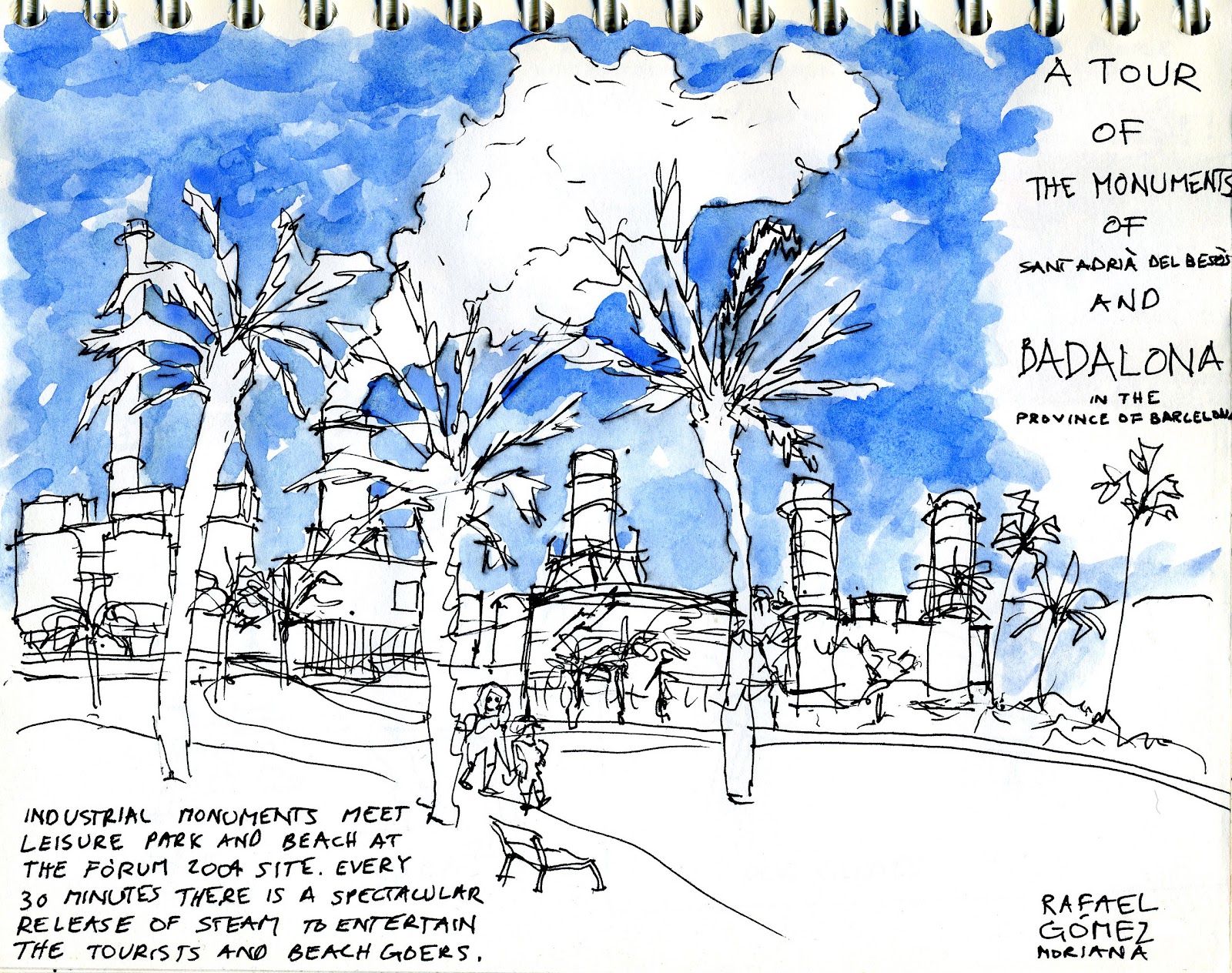
A Tour of the Monuments of Sant Adrià del Besòs and Badalona in the Province of Barcelona
2012/06/11
A Reminder to Urban Planners
Given the choice, most children would rather play in a terrain vague than a playground. They would rather make mud patties out of dirt using makeshift utensils fashioned from pieces of junk, even with "real" toy utensils at hand. Children in most western countries are so overprotected--and western cities so over-designed--that they rarely get a chance anymore to discover things for themselves and improvise, using only their hands and their imagination. Vive le terrain vague!
2012/06/03
Not So Different
"Spain is Different" was a tourism campaign slogan coined in the mid-1960s by dictator Francisco Franco's Ministry of Information and Tourism (!), when it was headed by the late Manuel Fraga Iribarne, a man who would transform into a democrat decades later and continue a long-lasting political career until his death this year at age 90. Fraga's slogan became very effective, not only attracting millions of tourists and therefore much-needed foreign currency to revive Spain's moribund economy decades after its devastating civil war, but also serving to re-brand Spain as "hip"and "fun" at a time when it was isolated and only beginning to gradually open up to the world. Fraga is also known for having relaxed censorship laws during the 1960s, leading to the emergence of the popular expression "con Fraga hasta la braga!" ("with Fraga all the way to the panties!"). Such actions led him to be perceived as a relative reformer from within the dictatorial regime, making him relatively popular at that time. After Franco's death in 1975, however, when students and workers protested massively to demand democracy, Fraga was the Interior Minister who publicly proclaimed "La calle es mía!" ("the street belongs to me!") and ordered police to shoot demonstrators, killing five and wounding many dozen. Needless to say, this heavy-handed action caused him to be largely despised thereafter, ruining the relatively good reputation he had enjoyed until then.
Curiously, a multinational corporation that designs and manufactures computer and entertainment products started out by similarly branding itself as "hip" and "fun" with a slogan that rings quite similar to "Spain is Different". And now, news of some rather heavy-handed and sordid business practices are similarly beginning to ruin its reputation.
Late in his life, Fraga dedicated his energy to an ambitious cultural and economic development project of which he is the brainchild, the City of Culture of Galicia, perhaps in an effort to restore his legacy. He organized an international competition in 1999 that was won by Peter Eisenman (an article I wrote on it can be read here), but curiously, one of the finalists in this competition, OMA, submitted a design for a building in the shape of a ring (a project which for some reason is not published on OMA's website). Coincidentally, the corporation whose slogan is "Think Different" is expected to soon begin construction of a building designed by Norman Foster that is shaped like...you guessed it: a ring.
Who would ever have thought that the story of a veteran politician from Spain and that of the world's biggest IT corporation could sound so similar, or perhaps better said: not so different?
2012/05/30
Architectural Art
![]() |
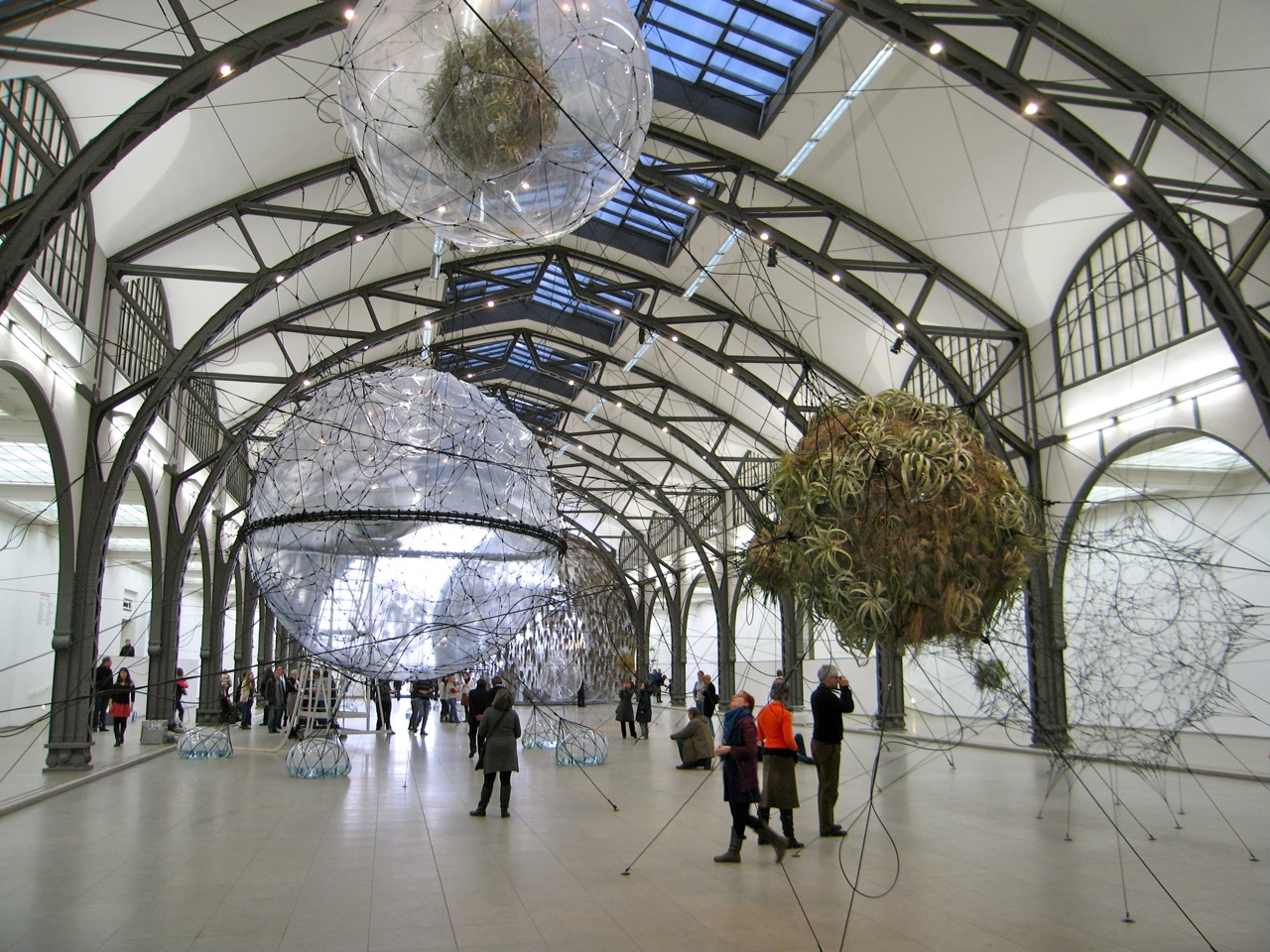
| Tomas Saraceno's Cloud Cities installation at Hamburger Bahnhof in Berlin |
Art galleries and museums seem to be showing with greater frequency artworks about architecture, many of them by artists who have studied architecture.
It's all very interesting, but is it architecture or is it art?
After all, art is a discipline that is completely open to every conceivable method, medium, and process. It has, for about a century now, been freed from the traditional academic categories of sculpture, painting and drawing to include conceptual art, installation art, performance art, land art, video art, photo-based art; and what we might call "architectural art" (which is arguably a form of installation art). Art is no longer restricted in terms of media, and is no longer practiced exclusively by painters or sculptors, but by artists who use multiple types of media to explore certain ideas from different angles. Architecture can be one of these ideas, and architectural construction one of those media, but if it's in an art institution, then it's art, not architecture.
There are fundamental differences between art and architecture. The most important one being that art is autonomous, while architecture has only a degree autonomy. In other words, art has an artistic freedom that architecture does not. But here we're obviously talking about architecture as "buildings", not gallery installations. As soon as an architect constructs something in a gallery (or in any institutional context involving a gallery or museum), then architecture becomes art.
When architecture occurs outside the privileged context of an art institution, however "artistic" or "sculptural" it may be, architecture will be architecture and not art.
2012/05/17
Architourism
![]() |
| Tourists at the Mies van der Rohe Pavilion in Barcelona |
But while architecture as cultural tourism is doing better than ever, architecture as building is in the doldrums in Spain, a country with a high number of living (not to say 'working') architects who are internationally respected. Something is surely wrong when an entire generation of talent sits idle while the talent of previous generations is increasingly consumed like fast food. But then again, it's a perfect sign of the Zeitgeist, isn't it?
2012/04/25
Paragraphs on Architectural Criticism
- Architectural criticism is a cultural activity. Culture is what distinguishes architecture from building (inasmuch as those two terms are distinguishable).
- Architecture is never logically or self-evidently right or wrong; only arguably better or worse. Criticism must therefore always be based on sound argument.
- Architectural criticism provides an interpretive reading of a work of architecture. This reading need not coincide with the architect’s stated intentions. In fact, it is much more interesting when a critical reading is different. The last thing a critic should ever be is a ‘spokesperson’ for an architect (or a politician, or a developer, or anyone else for that matter).
- A critic must demystify architecture without mystifying criticism in the process, testing works and if necessary challenging claims, calling bluffs, and denouncing charlatanry. Criticism must always be directed toward work and never toward persons.
- A critic is a public intellectual first and foremost, defending the public interest. To this end, they must always refuse to engage in whitewashing, greenwashing, or puff pieces.
- A built work of architecture is best criticized post-occupancy, i.e. after it has started to perform within the life-world. Otherwise, the criticism may be overly based on speculation or theory.
- Criticism, whether positive or negative, must be shared by all the ‘stakeholders’ involved in an architectural design project, including the client, planner, builder, consultants, and users (if these played a part in the design). Just as an architect has no right to claim exclusive credit for a built work when it is successful, they can similarly not be expected to shoulder all the blame for a project when it is unsuccessful. Built architecture is always a collaborative endeavour, for better or worse.
- Architectural criticism cannot ignore a work’s social, political, cultural and economic context; otherwise, it becomes solipsistic. But by the same token, it also can’t pass judgment based exclusively on such factors.
- A building that is problematic from an ethical standpoint can nevertheless possess certain architectural qualities. Conversely, just because a work of architecture is socially and environmentally worthy of praise does not automatically entail it is architecturally praiseworthy.
- Built work, precisely because it is part of a complex life-world that renders it imperfect, generally makes for much more nuanced criticism than so-called ‘paper architecture’.
- Architectural criticism cannot be based exclusively on renderings or photographs of buildings. Architecture has to be experienced in situ and ‘in the flesh’ in order to be fully appreciated. This is not to say that architectural photography cannot be a subject of critical review.
- Architectural criticism must be seen to be independent. It cannot be directly sponsored by corporations nor can it be seen to be too much in bed with professional associations, trade unions, guilds or religious organizations.
- Curating is not the new criticism, no matter how critical. While both have an effect upon the canon, they are fundamentally different; curatorial activity such as exhibitions often being a subject of critical review.
- Internet can be just as good a vehicle for architectural criticism as print. Neither medium is inherently more or less critical--what matters is the quality of the content.
- These paragraphs are neither conclusive nor certain. They constitute a theory of criticism that, like any other theory, is always up to be improved or debunked.
Subscribe to:
Posts (Atom)